Venture Global · VG
Venture Global has sold nearly all of 2026; its guidance now rides on the closing months
Venture Global lifted its 2026 EBITDA guidance to $10.0-10.3 billion; with 99% of cargoes sold, price barely matters this year, but the closing months must earn far more than last quarter did.
3 min read Published on

Published by
Inve Content team
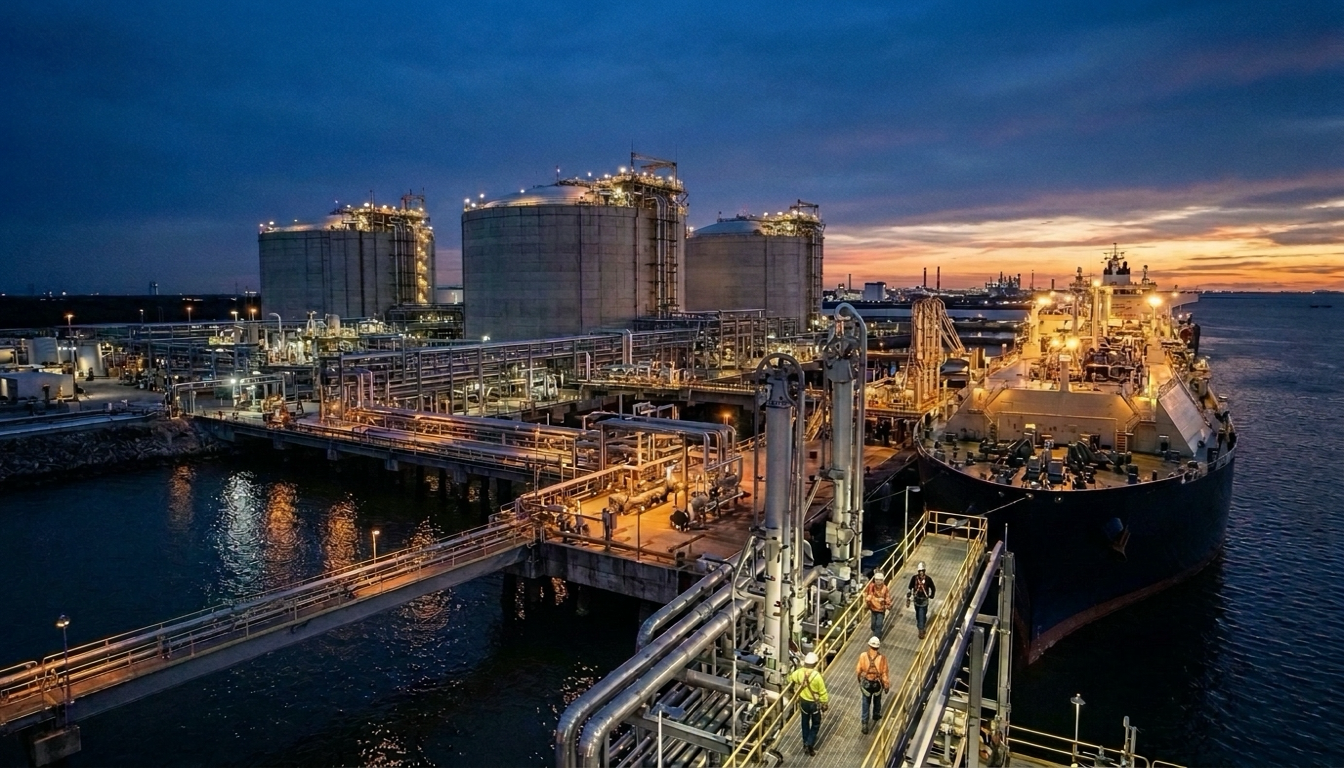
On 10 November Venture Global, which liquefies natural gas in Louisiana and ships it abroad, raised its guidance for 2026 Consolidated Adjusted EBITDA to $10.0 billion to $10.3 billion. That measure is the company's non-GAAP count of earnings before interest, tax, depreciation and amortisation, and it includes the share belonging to partners in its projects. The new range follows raises in May and August, and its midpoint is nearly twice that of the $5.2 billion to $5.8 billion the company set out in March. With almost every cargo for the year now sold, the 2026 number barely depends on the price of the few cargoes left. What it depends on is a strong final quarter, and the price exposure has moved on to 2027.
The year before ran the other way. Guidance for 2025 was cut in May 2025, held in August, cut again in November, and the year finished at $6.3 billion. The March 2026 range therefore opened below what the company had just earned.
The 2026 guide has climbed at each update this year; 2025's was cut in May and again in November
$bn
2025 guidance
- 7.1 Mar 2025
- 6.6 May 2025
- 6.6 Aug 2025
- 6.425 Nov 2025
- 6.3 2025 actual
2026 guidance
- 5.5 Mar 2026
- 8.35 May 2026
- 8.9 Aug 2026
- 10.15 Nov 2026
The reason price matters less is that the cargoes are spoken for. The company said 99% of the cargoes it expects to load in 2026 are now contracted. Each dollar-per-MMBtu change in the liquefaction fee, the charge for turning gas into a shipped cargo, on the remainder now moves the year's EBITDA by only $20 million to $30 million. In March, when 69% of the year's cargoes were contracted, the same move was worth $575 million to $625 million. For 2026, the number now turns mainly on loading the cargoes already sold.
A one-dollar swing in fees now barely moves 2026 EBITDA, after almost every cargo was sold
$m
- March 2026 600
- May 2026 325
- August 2026 195
- November 2026 25
That leaves the closing months of the year carrying the weight. Taking the EBITDA already earned in the first nine months of the year, the new range implies $3.55 billion to $3.85 billion for the rest of the year, calculated from the reported nine-month result and the guided range. That is well above what the September 2026 quarter produced. The raise, in other words, rests on what management expects from those months rather than on a jump that has already shown up in the results. Plaquemines Phase 1 began commercial operation on 31 October, and its cargoes now go to buyers on long-term contracts.
The full-year guide needs closing-quarter EBITDA 38% to 49% above last quarter's
$m
- Last quarter 2583
- Final quarter implied, low 3554
- Final quarter implied, high 3854
Those long-term contracts are also where 2027 begins to look different. Jack Thayer, the chief financial officer, said 2027 guidance will come with the next quarterly results, and he reminded listeners that "there will be an impact to contracted Phase 1 margins from the start of our long-term contracts at Plaquemines". He added continued pressure from the local price of the gas that plant buys, start-up costs at its CP2 project and spending on a new AI utility business.
That business is at an early stage. In October the company signed frame agreements with GE Vernova and Baker Hughes for power-island units, and it says it can begin delivering computing capacity in late 2028. Asked about it by an analyst, Mike Sabel, the chief executive, said: "We have the capital capacity to do it, but we haven't signed the deals yet."
For next year, Sabel said "the prevailing market prices will be the major driver of our earnings and EBITDA during 2027". In August the company put the sensitivity of 2027 EBITDA at $650 million to $700 million for each dollar-per-MMBtu change in fees, the kind of exposure that 2026 has now almost entirely shed.
The record: full financial tables
Financials
Income statement, last 8 quarters
| Quarter end | Sales | YoY | Operating profit | Op. margin | Other income | PBT |
|---|---|---|---|---|---|---|
| Sep 2026 | 4,756 | +42.9% | 2,295 | 48.3% | 893 | 3,188 |
| Jun 2026 | 4,578 | +47.6% | 2,188 | 47.8% | −435 | 1,753 |
| Mar 2026 | 4,599 | +58.9% | 1,151 | 25.0% | −415 | 736 |
| Dec 2025 | 4,445 | +191.7% | 1,718 | 38.7% | −251 | 1,467 |
| Sep 2025 | 3,329 | +259.5% | 1,320 | 39.7% | −683 | 637 |
| Jun 2025 | 3,101 | +179.9% | 1,038 | 33.5% | −447 | 591 |
| Mar 2025 | 2,894 | +104.7% | 1,080 | 37.3% | −412 | 668 |
| Dec 2024 | 1,524 | – | 594 | 39.0% | 644 | 1,238 |
Balance sheet
| As of | Equity | Debt | Cash | Fixed assets | Total assets |
|---|---|---|---|---|---|
| Sep 2026 | 11,064 | 44,612 | 3,420 | 57,368 | 68,108 |
| Jun 2026 | 8,572 | 41,814 | 3,120 | 53,216 | 61,515 |
| Mar 2026 | 7,233 | 36,582 | 1,599 | 49,754 | 56,300 |
| Dec 2025 | 6,743 | 34,205 | 2,355 | 46,588 | 53,446 |
Cash flow
| Year end | Operating | Investing | Financing | Free cash flow |
|---|---|---|---|---|
| Dec 2025 | 6,566 | −13,220 | 5,465 | −6,799 |
| Dec 2024 | 2,149 | −14,159 | 10,752 | −11,568 |
| Dec 2023 | 4,550 | −8,725 | 7,635 | −3,541 |