
Vail Resorts · MTN
Vail's new resort profit guide lands just under fiscal 2025, on more revenue and a thinner balance sheet
Vail Resorts guided next year's resort profit to a midpoint of $835 million, just below fiscal 2025's $844.1 million, while pass sales fell and debt stayed heavy.
Published · Updated · Inve Research Desk
$835M
FY27 Resort Reported EBITDA guide midpoint (non-GAAP)
The company guides to a little less than fiscal 2025's $844.1M, on revenue about 4.9% above fiscal 2025's ($3,108M against $2,963.9M, by our arithmetic): costs are growing faster than sales.
How they did last quarter
Vail met the lowered guide it set in June, but the year finished 14.3% under the original midpoint, by our arithmetic.
- Resort Reported EBITDA, FY26 (non-GAAP)$745.7M, against $844.1M in fiscal 2025vs 8 June 2026 guidance of $735M-$755M; the CFO said the result "landed in line with the midpoint of the range we provided in June"On target against the 8 June guide, the last of four reductions made between January and June.
- Resort Reported EBITDA, final quartera loss of $122.4M, on Resort net revenue up 0.3% to $272.1Mvs a loss of $123.6M a year ago, with Australian snowfall 57% below its ten-year averageThe seasonal Resort EBITDA loss narrowed by $1.2M, mainly because the year-ago quarter carried $8.1M of CEO transition costs; the net loss widened to $190.2M from $182.4M.
- Skier visits and lift revenue, FY26visits down 13.4%, lift revenue down only 3.5%vs a year ago, with pass revenue up 3.9%Season passes cushioned the weather: revenue fell far less than visits.
- Leverage at 31 July 2026 (non-GAAP)3.9x net debt to trailing twelve months Total Reported EBITDAvs 3.5x reported on 8 June 2026 and 3.1x on 9 March 2026Leverage has risen at each reading since March.
The new guide ends up just short of fiscal 2025
Vail Resorts guided its next fiscal year at the end of September. Resort Reported EBITDA, which the company labels non-GAAP and which is the profit of its ski and lodging operations before depreciation and interest, is guided to a midpoint of $835 million, against $844.1 million in fiscal 2025. The company is therefore guiding to slightly less than that, on resort revenue about 4.9% higher than that year's, by our arithmetic.
The reason is in the costs. The chief financial officer said "inflation growth is outpacing our revenue growth, resulting in margin pressure compared to the original outlook". The new savings the company expects are small beside inflation of about 4%; the chief financial officer also named incentive pay coming back and more marketing spend.
The last guide was lowered four times, then met
In January the company said Resort Reported EBITDA would land just below the low end of its original $842M–$898M range; in March it cut the range to $745M–$775M; in April it said the result would be at or around that low end; and on 8 June it set $735M-$755M, which the company put at about 14% below its original outlook at the midpoint. That is four guide changes between January and June, counted against the opening guide, the last formalising April's update, and the year then ended inside the June range.
The stated cause each time was weather, and the new guide assumes normal weather in North America, Europe and Australia.
Pass units are down 12%, and the guide assumes pass sales do not improve
A pass bought in advance is revenue already known, so the pass book is where next winter's visibility sits. Pass units are down 12% on a year earlier, two points below the spring-deadline reading, though the company calls the trend through Labor Day consistent with spring when auto-renew is excluded. The company said "we are not expecting an overall improvement during the rest of the selling season".
Management says this may suggest delayed decision-making among lower-frequency guests, who may buy later or buy lift tickets instead. The guide then relies on lift tickets to recapture a meaningful part of the gap. We don't know yet whether they will; the next data point is the final pass count after the early-December deadline. Passes cushioned the weather-hit season, as pass revenue rose while visits fell.
The balance sheet, not the snow, has the least slack
Net debt is 3.9x trailing twelve months Total Reported EBITDA, also non-GAAP, higher than at the June update and in March. Management expects about 3.5x by the end of next year, assuming net debt does not change; by our arithmetic that needs the guide's midpoint, and at the low end it would be about 3.7x. Total debt was little changed since October, while cash fell by more than half. Equity is well below a year earlier.
The dividend is the other claim on cash. Free cash flow was $248.0 million in fiscal 2026, and the dividends declared come to about $317 million, so by our arithmetic they were not covered. Operating cash flow has fallen in each of the last three fiscal years. The CFO said "we expect to generate positive free cash flow after continuing to fund our capital program and dividends" even at the low end. Building that case ourselves from the low end gives roughly break-even to slightly short, before working capital.
Cash and equity at the last four quarter ends
Total debt was $3,186.4M at 31 July, little changed from $3,173.0M at 31 October, while cash fell from $581.5M to $231.3M across the four quarter ends shown.
$ million
| Cash | Equity | |
|---|---|---|
| Oct 2025 | 582 | 157 |
| Jan 2026 | 385 | 302 |
| Apr 2026 | 371 | 552 |
| Jul 2026 | 231 | 241 |
Operating and free cash flow, fiscal 2023 to 2026
Operating cash flow fell in each of the last three years; free cash flow fell in fiscal 2025 and 2026, and the latest $248.0M sits below the dividends declared for the year, about $317M by our arithmetic.
$ million
| Operating cash flow | Free cash flow | |
|---|---|---|
| Jul 2023 | 638 | 323 |
| Jul 2024 | 589 | 378 |
| Jul 2025 | 555 | 320 |
| Jul 2026 | 480 | 248 |
Five nominees for the board, and no questions taken
On the call the chief executive said the company had received notices of intent to nominate directors, that the Board was weighing them, and that it would take no questions on the matter. The release added stockholder activism and a possible proxy contest to its risk factors.
A September release named the nominees: Robert A. Chapek, M. Ashton Hudson, Bryce Roberts and Picabo Street, put forward by Oasis Management, and Gregory Syvert Meyer, who nominated himself. Oasis filed a Schedule 13D later that month. In it, Oasis said a reconstituted board could sharpen the company's focus on guest experience, pricing strategy, marketing effectiveness and use of its hospitality assets.
What the next few months will show
Three things settle most of this. The final pass count after the early-December deadline will show whether the late buyers arrive. The capital plan the company said it will give in December will show what it means to keep spending. And the proxy statement will show the Board's slate.
It has now set the next guide near the old profit level, from more revenue and a thinner balance sheet. A company that changed its guide four times since FY26 began, counted against the opening guide, the last step formalising April's, and then sets the bar there, is asking to be judged on the next pass count, not on the year.
The record: notes, full financial tables
Notes
Impact 4/5 Guidance Mixed
Vail guides FY27 resort EBITDA to $805M-$865M, a $835M midpoint below FY25's $844.1M
Vail Resorts guided fiscal 2027 Resort Reported EBITDA (non-GAAP) to $805M-$865M on 28 September 2026. The $835M midpoint is $9.1M under fiscal 2025's $844.1M and $89.3M above fiscal 2026's $745.7M, on revenue about 4.9% above fiscal 2025's; these comparisons are by our arithmetic. In September 2025 the company guided fiscal 2026 to $842M-$898M, a margin near 28.8%; this guide implies about 26.9%.
“inflation growth is outpacing our revenue growth, resulting in margin pressure compared to the original outlook”— Angela Korch, Chief Financial Officer
Impact 4/5 Demand Negative
Vail's pass units are down 12% through 18 September, against 10% at the spring deadline
Vail Resorts said season pass units were down 12%, days sold down 10% and dollars down 6% through 18 September 2026, against the year-ago period. At the spring deadline the company had reported units down 10% and dollars down 5%, so units are two points and dollars one point lower, though the company calls the trend consistent with spring excluding auto-renew. The fiscal 2027 guide assumes no improvement in pass sales and relies on lift tickets to recapture part of the gap.
“we are not expecting an overall improvement during the rest of the selling season”— Angela Korch, Chief Financial Officer
Impact 4/5 Balance sheet Negative
Vail's net debt reaches 3.9x EBITDA as the dividend is held and cash falls to $231.3M
Vail Resorts reported net debt of 3.9x trailing twelve months Total Reported EBITDA (non-GAAP) at 31 July 2026, up from 3.5x on 8 June and 3.1x on 9 March. Total debt was $3,186.4M, little changed from $3,173.0M at 31 October 2025, while cash fell from $581.5M to $231.3M. Fiscal 2026 free cash flow of $248.0M was below about $317M of dividends declared, by our arithmetic. The company says free cash flow stays positive after dividends even at the low end of its guide.
“we expect to generate positive free cash flow after continuing to fund our capital program and dividends”— Angela Korch, Chief Financial Officer
Impact 4/5 Risk Mixed
Five people are nominated for Vail's board, four by Oasis; the call took no questions
Vail Resorts' 11 September 2026 release named the nominees: Robert A. Chapek, M. Ashton Hudson, Bryce Roberts and Picabo Street via Oasis Management, and a self-nomination by Gregory Syvert Meyer. Oasis filed a Schedule 13D on 16 September, the company's 28 September release lists stockholder activism and a potential proxy contest among its risk factors, and on that day the chief executive took no questions on the nominations.
“we have received notices of intent to nominate individuals for election to our Board of Directors”— Robert Katz, Chief Executive Officer
Impact 3/5 Guidance Mixed
Vail met its FY26 guide after lowering the opening guide four times since FY26 began
Vail Resorts' fiscal 2026 Resort Reported EBITDA (non-GAAP) came in at $745.7M, within $1M of the 8 June guide's $745M midpoint. Counted against the opening guide of $842M-$898M, the company changed it four times since FY26 began, between 15 January and 8 June 2026 (15 January, 9 March, 23 April, 8 June), the last step formalising April's update. The 8 June range of $735M-$755M was, the company said, about 14% below its original outlook at the midpoint; by our arithmetic the result is 14.3% under the original midpoint of $870M.
“last season was a true anomaly and it certainly creates risk heading into next season”— Robert Katz, Chief Executive Officer
Financials
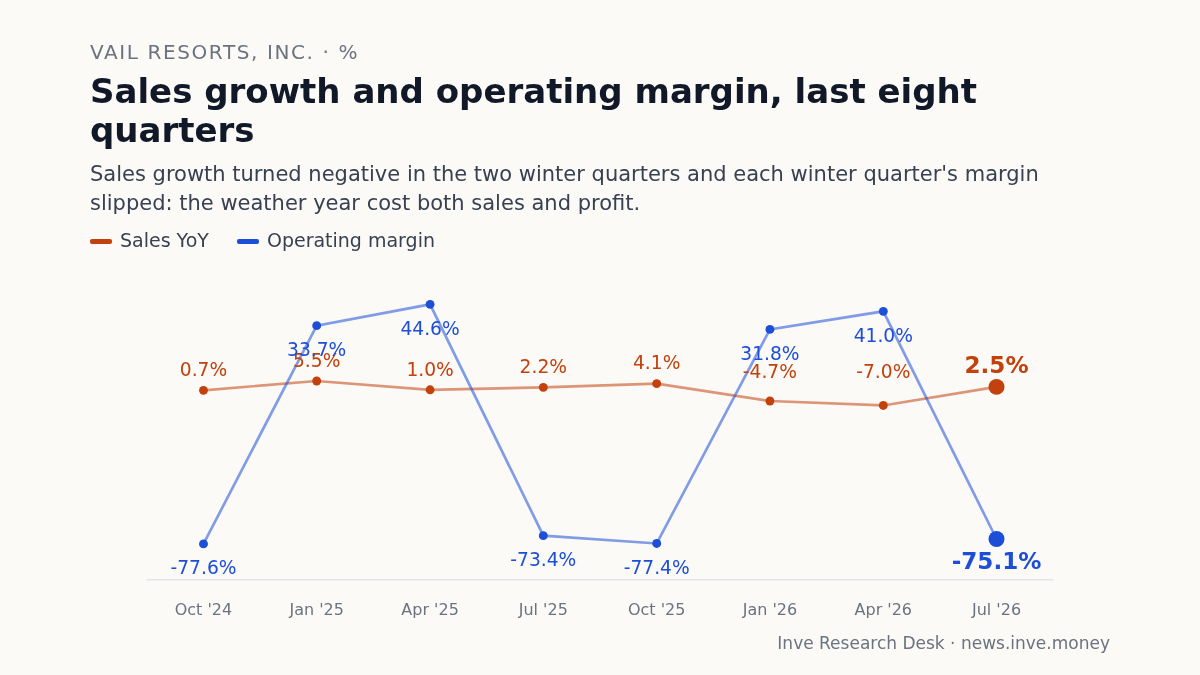
Income statement, last 8 quarters
| Quarter end | Sales | YoY | Operating profit | Op. margin | PBT | Net profit |
|---|---|---|---|---|---|---|
| Jul 2026 | 278 | +2.5% | −209 | −75.1% | −260 | −190 |
| Apr 2026 | 1,205 | −7.0% | 494 | 41.0% | 446 | 314 |
| Jan 2026 | 1,084 | −4.7% | 345 | 31.8% | 298 | 210 |
| Oct 2025 | 271 | +4.1% | −210 | −77.4% | −257 | −187 |
| Jul 2025 | 271 | +2.2% | −199 | −73.4% | −242 | −181 |
| Apr 2025 | 1,296 | +1.0% | 578 | 44.6% | 541 | 390 |
| Jan 2025 | 1,137 | +5.5% | 383 | 33.7% | 343 | 244 |
| Oct 2024 | 260 | +0.7% | −202 | −77.6% | −240 | −173 |
Balance sheet
| As of | Equity | Debt | Cash | Investments | Fixed assets | Total assets |
|---|---|---|---|---|---|---|
| Jul 2026 | 241 | 3,186 | 231 | 37.1 | 2,340 | 5,526 |
| Apr 2026 | 552 | 3,023 | 371 | – | 2,371 | 5,686 |
| Jan 2026 | 302 | 2,931 | 385 | – | 2,414 | 5,600 |
| Oct 2025 | 157 | 3,173 | 582 | – | 2,380 | 5,764 |
Cash flow
| Year end | Operating | Investing | Financing | Free cash flow |
|---|---|---|---|---|
| Jul 2026 | 480 | −266 | −421 | 248 |
| Jul 2025 | 555 | −205 | −243 | 320 |
| Jul 2024 | 589 | −241 | −577 | 378 |
| Jul 2023 | 638 | −273 | −914 | 323 |