
UnitedHealth Group Incorporated · UNH
UnitedHealth: 2027 consensus may be too low; low end of 13%-16% a start, after a sales fall
UnitedHealth raised its 2026 adjusted EPS floor to $20.50 and called the low end of 13% to 16% growth a more reasonable starting point for 2027, but sales fell and the medical care ratio includes $610 million of reserve releases.
Published · Inve Research Desk
UnitedHealth Group Incorporated stock page → More news from Oct 13, 2026

$20.50
2026 adjusted EPS floor, up from more than $17.75 in January
Raised at each update since January, it now sits beside a 2027 starting point of about $23.17 a share, by our arithmetic.
How they did last quarter
Earnings came in well ahead of a year ago and margin improved, but sales fell and the medical care ratio includes $610 million of favorable reserve development.
- Adjusted earnings per share$4.69, against $2.92 a year agovs The same quarter a year earlier: $2.92Up about 61%, and ahead of what July's range implied for the quarter, by our arithmetic.
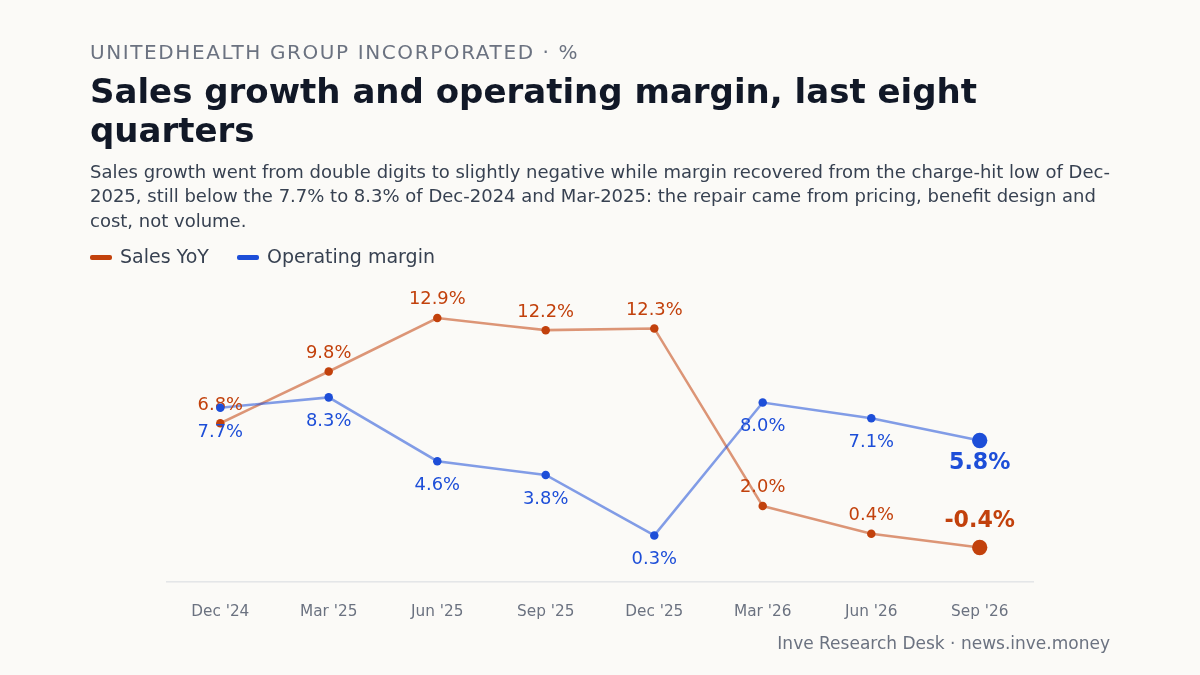
- Sales$112,694 million, down 0.4% on a year agovs The quarter before: $112,032 million, up 0.4% on a year agoThe first year-on-year fall in the eight quarters shown, by our arithmetic, so earnings growth cannot rest on volume.
- Operating margin5.8%vs 3.8% a year ago and 7.1% the quarter beforeBetter than a year ago, lower than the quarter before, and still below the 7.7% of Dec-2024 and 8.3% of Mar-2025 shown in the exhibit.
- Medical care ratio88.4%, against 89.9% a year agovs About 89.1% excluding $610 million of reserve development, by our arithmeticWithout the release, about 89.1% by our arithmetic, against 89.9% as reported a year ago; the release gives no year-ago development figure, so the underlying gain cannot be told.
A floor raised three times, now carried into next year
The number a holder of UnitedHealth waits for is the floor on this year's adjusted earnings per share. In January it was only a floor too. It is now at least $20.50, raised at each of the three updates since January's.
The chief financial officer then said current analyst consensus for next year may understate the opportunity, and that management sees "a more reasonable starting point" in the lower end of its long-term growth range. On the new floor that is about $23.17, by our arithmetic: a floor on a floor, with a fuller outlook due before year-end.
Last quarter's earnings growth came without sales growth
Sales fell on a year ago last quarter, the first year-on-year fall in the eight quarters shown. So this quarter's repair did not come from a bigger top line, and on the call no membership guide for next year was given. It came through margin, and there the repair is real: operating margin was 5.8% last quarter against 3.8% a year ago.
Management lists repurchases as a tailwind, but the diluted share count is only 0.7% lower than a year ago. Last quarter's growth in earnings per share came from the company keeping more of each revenue dollar: operating profit rose about half on lower sales.
Medical care ratio includes $610 million of reserve releases
The medical care ratio, the share of premiums paid out as medical costs, was 88.4% last quarter, and the release says that includes $610 million of favorable development on reserves. The quarter before had a similar release, larger still.
Without this quarter's, the ratio would be about 89.1%, by our arithmetic, against 89.9% as reported a year ago; the release gives no development figure for the year-ago quarter, so how much of the improvement is underlying cannot be told. This need not be bad news: days of claims payable were flat on the quarter before, so reserves did not shrink against claims. The case for next year is easier to believe if the ratio holds without releases.
The new floor implies a modest fourth quarter
Subtracting nine months from the new floor leaves at least $2.20 for the fourth quarter, against $2.13 a year earlier.
If July's guidance of slightly more in the third quarter than the fourth meant a roughly even split of the second half, the fourth quarter would have been about $3 (a rough estimate of ours). The third quarter ran ahead of July's phasing, yet the floor rose by less, so the new floor leaves less for the fourth quarter than July's split did; the CFO's stated reason is expected investments in the final months of the year.
Leverage rose in the quarter
Debt was 41.7% of total capital at quarter end, up from the quarter before. Management's year-end goal is a ratio near 40.0%; in January it aimed to reach it, and it now says it is on track to approach it. At today's equity, reaching exactly that needs debt about $4.9 billion lower, by our arithmetic, and approach may not need all of it.
Meanwhile the company raised its buyback guidance for this year on the July call to double the initial figure, and has now bought back that much, so it chose both goals.
Debt and equity, last four quarter ends
Debt fell from December but rose in the latest quarter while equity slipped, so the ratio moved away from the 40% goal.
$ million
| Debt | Equity | |
|---|---|---|
| Dec 2025 | 78,389 | 100,090 |
| Mar 2026 | 77,917 | 103,895 |
| Jun 2026 | 73,328 | 104,513 |
| Sep 2026 | 74,331 | 104,129 |
What has to be true, and when we will know
Management's case rests on three things. The first is the quality of earnings, which the chief financial officer called "strong and durable". The second is Medicaid margin improvement next year, from a trough year toward rated margins that management calls aspirational for the end of 2028. The third is Optum Health moving toward its 6% to 8% margin target, which its executive expects to make strong progress on in 2027, after revenue fell almost a tenth.
We do not yet know how the outlook due before year-end compares with the $23.17 figure, nor what membership it assumes. A company that raises its floor each time it clears it teaches its owners to read the floor as the forecast. That outlook will show whether the habit holds.
UnitedHealth Group Incorporated stock page →
The record: notes, full financial tables
Notes
Impact 4/5 Guidance Mixed
UnitedHealth: low end of 13%-16% a 2027 starting point, about $23.17 by our arithmetic
The chief financial officer said the low end of the long-term 13% to 16% growth range is a more reasonable starting point for 2027, and that consensus may understate what lies ahead. In July the whole range was applied to a 2026 base of $19.50 to $20; now it is the low end on a base of at least $20.50, which is about $23.17, by our arithmetic. Sales fell 0.4% in the September 2026 quarter, so this quarter's repair came from margin, not sales.
“we see the lower end of our long-term 13% to 16% growth rate as a more reasonable starting point”— Wayne DeVeydt, chief financial officer
Impact 4/5 Guidance Mixed
UnitedHealth's $20.50 adjusted EPS floor leaves at least $2.20 for Q4, by our arithmetic
Management raised 2026 adjusted earnings per share guidance to at least $20.50, from $19.50 to $20.00 in July. Nine months delivered $18.30, so by our arithmetic the guidance implies at least $2.20 for the fourth quarter, against $2.13 a year earlier. If July's guidance of slightly more in the third quarter meant a roughly even split of the second half, the third quarter beat that by about $1.4 to $1.7 (a rough estimate of ours), while the guide moved up by $0.50 to $1.00.
“reflects performance through the third quarter, balanced by expected investments in the final months of the year”— Wayne DeVeydt, chief financial officer
Impact 3/5 Margin Mixed
UnitedHealth's 88.4% medical care ratio includes $610 million of reserve releases
The medical care ratio, medical costs as a share of premiums, was 88.4% in the September 2026 quarter against 89.9% a year earlier as reported. The release says that includes $610 million of net favorable prior-period reserve development, after $860 million reported in July for the quarter before. By our arithmetic the ratio would be about 89.1% without the $610 million; the release gives no development figure for the year-ago quarter, so the underlying gain cannot be stated. In July the chief financial officer said the $19.50 to $20 base reflects prior period development.
“The quality of earnings is strong and durable as we head into 2027.”— Wayne DeVeydt, chief financial officer
Impact 3/5 Margin Positive
UnitedHealth now sees Medicare margin near the top of 2%-4% and Medicaid better than -1%
UnitedHealthcare executives lifted their 2026 margin outlook for government programs. Core Medicaid margin for 2026 remains negative but is now expected moderately better than negative 1%, and a UnitedHealthcare executive who gave the name Bobby said Medicare Advantage is near the top end of its 2% to 4% range. In July the Medicaid range was negative 1% to negative 1.7% and Medicare was above 3%. UnitedHealthcare's operating margin was 3.3% in the September 2026 quarter against 2.1% a year earlier, and rated Medicaid margins remain an aspiration for the end of 2028.
“we continue to view 2026 as a trough year for core Medicaid margins, which we now expect to be moderately better than negative 1%”— Timothy Noel, UnitedHealthcare executive
Impact 3/5 Guidance Mixed
Optum Health's nine months leave room for a Q4 loss up to $859 million, by our arithmetic
Optum Health earned $3,074 million of adjusted earnings from operations in nine months, against July's guide of more than $2,215 million on an adjusted basis (more than $2,275 million reported). By our arithmetic the first half had reached about $2,486 million (nine months less the third quarter's $588 million), so the floor was passed before this call; a fourth-quarter adjusted loss up to $859 million would still meet it. An analyst said the floor still implies a meaningfully negative fourth quarter; on the call the Optum Health executive cited risk seasonality and additional investments, without a figure. Revenue fell 9.9% in the September 2026 quarter on fewer value-based patients.
“fourth quarter does reflect risk seasonality, which is normal course for this business and some additional investments that we're making for long-term performance”— Krista Nelson, Optum Health executive
Impact 3/5 Balance sheet Mixed
UnitedHealth debt-to-capital rises to 41.7%; the call now says approach 40%, not reach
Debt to total capital was 41.7% at the end of the September 2026 quarter, up from 41.2% at the end of June. In January management aimed to reach about 40% before year-end; the call now says it is on track to approach 40%, while the release still states a target of approximately 40.0% by year-end. By our arithmetic, reaching exactly 40.0% at today's equity needs debt about $4.9 billion lower, and approach may need less. The company raised its 2026 buyback guidance from an initial $2.5 billion to at least $5 billion in July and has now done $5.0 billion.
“Our debt to cap ratio was 41.7% at the close of the quarter and we remain on track to approach 40% by year-end.”— Wayne DeVeydt, chief financial officer
Financials
Income statement, last 8 quarters
| Quarter end | Sales | YoY | Operating profit | Op. margin | PBT | Net profit |
|---|---|---|---|---|---|---|
| Sep 2026 | 112,694 | −0.4% | 6,563 | 5.8% | 5,524 | 4,110 |
| Jun 2026 | 112,032 | +0.4% | 7,991 | 7.1% | 6,968 | 5,484 |
| Mar 2026 | 111,721 | +2.0% | 8,990 | 8.0% | 7,963 | 6,280 |
| Dec 2025 | 113,215 | +12.3% | 380 | 0.3% | −720 | 10 |
| Sep 2025 | 113,161 | +12.2% | 4,315 | 3.8% | 3,229 | 2,348 |
| Jun 2025 | 111,616 | +12.9% | 5,150 | 4.6% | 4,082 | 3,406 |
| Mar 2025 | 109,575 | +9.8% | 9,119 | 8.3% | 8,106 | 6,292 |
| Dec 2024 | 100,807 | +6.8% | 7,773 | 7.7% | 6,791 | 5,543 |
Balance sheet
| As of | Equity | Debt | Cash | Investments | Fixed assets | Total assets |
|---|---|---|---|---|---|---|
| Sep 2026 | 104,129 | 74,331 | 28,549 | – | – | 312,782 |
| Jun 2026 | 104,513 | 73,328 | 28,585 | 2,883 | 10,762 | 309,727 |
| Mar 2026 | 103,895 | 77,917 | 28,001 | 3,228 | 10,667 | 312,644 |
| Dec 2025 | 100,090 | 78,389 | 24,365 | 3,756 | 10,762 | 309,581 |
| Sep 2025 | 101,569 | 80,136 | 27,210 | 3,404 | 11,104 | 315,269 |
Cash flow
| Year end | Operating | Investing | Financing | Free cash flow |
|---|---|---|---|---|
| Dec 2025 | 19,697 | −8,685 | −11,644 | 16,075 |
| Dec 2024 | 24,204 | −20,527 | −3,512 | 20,705 |
| Dec 2023 | 29,068 | −15,574 | −11,529 | 25,682 |
| Dec 2022 | 26,206 | −28,476 | 4,226 | 23,404 |