
PepsiCo · PEP
PepsiCo cut its earnings guide after a quarter flattered by tariff refunds
International growth carried PepsiCo's latest quarter while North American profit fell, and tariff refunds flattered the total; three months after reaffirming, the company cut its core earnings guide.
Published · Inve Research Desk

-0.6%
core profit change without refunds, by our arithmetic
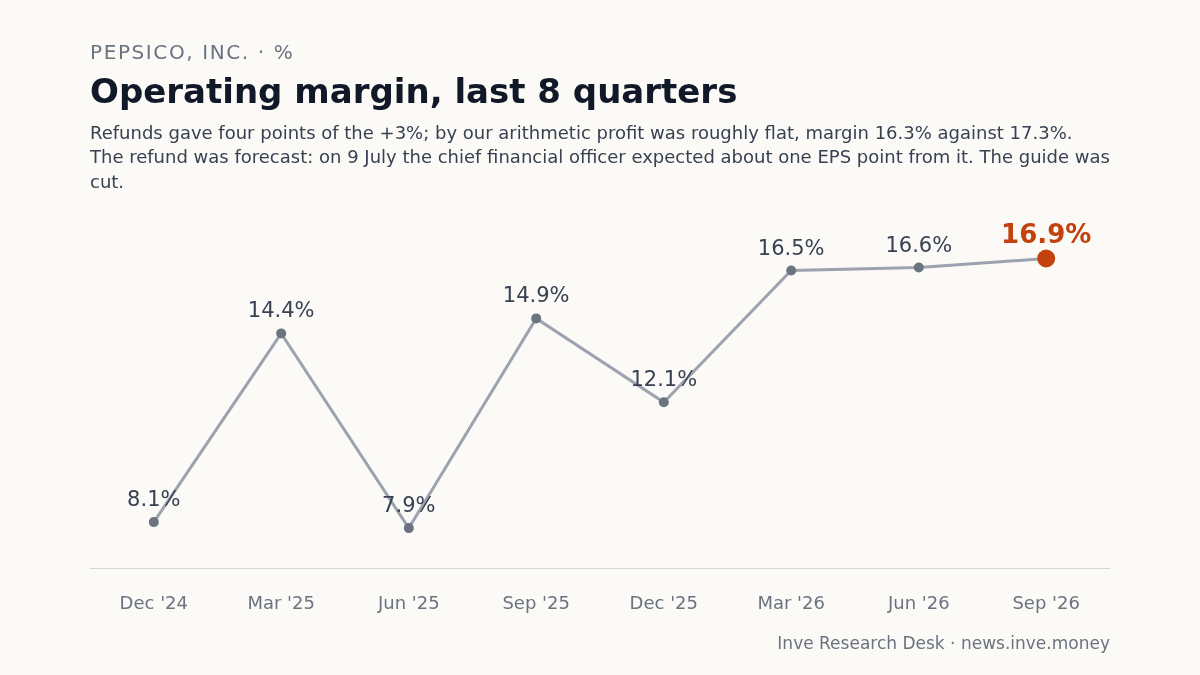
Refunds gave four points of the +3%; by our arithmetic profit was roughly flat, margin 16.3% against 17.3%. The refund was forecast: on 9 July the chief financial officer expected about one EPS point from it. The guide was cut.
How they did last quarter
In the quarter to 5 September 2026: worse than said in July. The tariff refund it had forecast arrived and supplied most of the profit growth, snack profit fell, and the earnings guide was cut.
- Core operating profit$4,277 million, +3% on a year ago; roughly flat (about -0.6%, using the release's rounded four points) without tariff refunds, by our arithmeticvs $4,137 million a year ago; the release credits tariff refunds with a 4-percentage-point favorable impactUnderlying profit did not grow; the refund did the work.
- PepsiCo Foods North America core profit$1,382 million, -12%, on organic volume +0.5%vs February chief executive expectation: "We expect Frito-Lay to grow volume, net revenue and operating margin this year." In April the chief financial officer said margin would be managed as a total companyVolume held over the year to date, but revenue and margin have so far fallen short of the February line.
- Organic revenue growth+3.1% in the quarter, +2.7% over the year to datevs Previous full-year guide "+2% to +4%", now "Approximately +3%"Inside the old range; the company narrowed to the midpoint of the old range.
- Core EPS growth guidanceCore EPS $2.34 against $2.29 a year ago, +2%; full-year guide cut to +2.5% to +3.5%vs Previous full-year guide, printed in the release as "Low-end of +5% to +7%"; on 9 July the chief financial officer reaffirmed guidance and said earnings might land toward the low endThe guide fell below the bottom of the range the company had reaffirmed three months earlier.
A tariff refund carried the profit growth
PepsiCo said in its results that core operating profit rose 3% in its third quarter of fiscal 2026. The release names the causes: productivity savings, net pricing and a favorable effect from tariff refunds worth four percentage points of that growth. Take the refund out and, by our arithmetic using the release's rounded figure, core profit was roughly flat, and the core margin was roughly a point below a year ago. On that measure the quarter had no profit growth. The refund was not unexpected: in July the chief financial officer said refund claims for tariffs paid last year would add about one point of EPS growth, likely in this quarter, and would help offset commodity costs. The guide he reaffirmed then already counted on it.
The chief financial officer described the beverage benefit as one that will go away: North American beverages had a tariff-related benefit in the quarter, he said, and once it goes away there is more underlying pressure than the quarter showed.
In North America, snacks lost profit and drinks lost volume
In February the chief executive set growth targets for Frito-Lay this year: more volume, more revenue and a wider operating margin. The reported segment is PepsiCo Foods North America, which holds all of the company's convenient foods in the United States and Canada. Its core operating profit fell on flat revenue, and its core margin was well below a year ago, by our arithmetic. In April the chief financial officer, asked whether margin expansion in the segment was still expected, said the company would manage margin as a total company, with as much flexibility as possible inside the segments. So the February line was already qualified. Even so, by our reading of the year so far, volume was met, revenue was not and margin was not.
The beverage side had its own trouble. PepsiCo Beverages North America saw organic volume fall 3%. The chief executive said the company is competing well in hydration and energy but not in soft drinks. PepsiCo Beverages North America's core operating profit rose from a year ago, helped by a tariff benefit the chief financial officer placed in this business.
International kept the company growing
Outside North America the picture runs the other way. By our arithmetic, all of the company's organic revenue growth in the quarter came from the international segments, while North America's organic revenue slipped slightly. Over the year to date, international was 45% of segment core operating profit, up from 40% a year earlier, by our arithmetic. The chief executive called international's growth structural, not weather (the analyst had also named the World Cup). North America is still more than half of segment core operating profit over the same 36 weeks, by our arithmetic, so its shortfall still sets the total.
The guide came down three months after it was reaffirmed
On 9 July the chief financial officer reaffirmed the full-year guidance but said earnings might land toward the low end of the range. On 8 October the company cut its core earnings-per-share growth guidance to +2.5% to +3.5%, from the low end of +5% to +7%. The cut is larger in constant currency, which strips out exchange rates: +1% to +2%, from the low end of +4% to +6%. Currency is now about +1.5 points to core EPS, from about +1, and the core tax rate is lower; by our arithmetic both flatter the reported range.
Organic revenue growth was narrowed to the midpoint of its old range. Net revenue growth was raised to the top of its old range, and by our arithmetic that raise is currency and acquisitions, not underlying sales.
The chief financial officer put the reason down to margin, not sales: input costs are rising and product mix is working against the company, and hedges are rolling off, so commodity costs climb in the fourth quarter. The company's stated answer is structural cost cuts and revenue management, which the chief financial officer said should start helping as the calendar year turns. By his timing the cushions end first: hedges roll off in the fourth quarter, and the benefits start only as the calendar year turns.
What we do not know yet
Asked about bigger structural changes, the chief executive said the company is open to revisiting every option, and raised expanding or accelerating refranchising in some parts of the country, where he said the company has good partners. In February 2026 he had described refranchising as very small parts of the country; now he asks whether to expand or accelerate it. He announced no decision on the call.
The sequence so far is a reaffirmation with a warning in July, a cut in October, and a view of next year that the chief financial officer said will come with fourth-quarter results in February 2027.
The record: notes, full financial tables
Notes
Impact 5/5 Guidance Negative
PepsiCo cuts FY26 core EPS guide to +2.5% to +3.5% from low end of +5% to +7%
PepsiCo cut its 2026 core earnings-per-share growth guidance to +2.5% to +3.5%, from the low end of +5% to +7%, and its constant-currency range to +1% to +2%, from the low end of +4% to +6%. The chief financial officer pointed to rising input costs and mix. On 9 July the company had reaffirmed the range while saying earnings might land toward the low end. A view of 2027 comes with fourth-quarter results in February 2027.
“Input costs are trending higher and mix has been a headwind in particular.”— Stephen Schmitt, Chief Financial Officer
Impact 4/5 Margin Negative
PepsiCo core profit up 3%, but tariff refunds supplied 4 points of the growth
Core operating profit rose 3% to $4,277 million in the quarter to 5 September, and the release credits tariff refunds with four percentage points of that growth, a figure the release gives for the company as a whole. The refund was flagged: on 9 July the chief financial officer expected about a point of EPS from it. By our arithmetic, using the release's rounded four points, core profit was roughly flat to slightly down (about -0.6%) and the core margin about 16.3%, against 17.3% a year ago. The chief financial officer placed a tariff benefit in Beverages North America, so the quote is not read as the whole amount.
“we did have a benefit in our Beverage North America business in the third quarter related to tariffs”— Stephen Schmitt, Chief Financial Officer
Impact 4/5 Margin Negative
PepsiCo Foods North America core profit falls 12% to $1,382 million on flat revenue
PepsiCo Foods North America, its US and Canadian convenient foods, saw core operating profit fall 12% to $1,382 million in the quarter to 5 September, with organic volume up 0.5%. In February 2026 the chief executive said he expected Frito-Lay to grow volume, revenue and margin this year; in April 2026 the chief financial officer said margin would be managed as a total company. Over the 36 weeks to 5 September, by our arithmetic, revenue was down 0.1% and core margin was 22.2% against 24.1%; the release shows volume up 1%. In the same answer as the quote, the chief executive said he was happy with the snack volume turnaround.
“Now we're not satisfied with the performance in the U.S.”— Ramon Laguarta, Chairman and CEO
Impact 3/5 Demand Negative
PepsiCo Beverages North America organic volume falls 3%; CEO says soft drinks lag
PepsiCo Beverages North America's organic volume fell 3% in the quarter to 5 September, while beverage volume was down 2%. Core profit rose to $1,012 million from $975 million, with a tariff benefit the chief financial officer placed in this business inside it, and core margin was 13.1% against 13.3% (12.4% against 12.8% over 36 weeks), by our arithmetic. In February the chief executive said the company planned to keep improving that margin; in April the chief financial officer said margin would be managed as a total company, with flexibility inside the segments.
“we're competing well in some platforms like hydration, like energy, and we're not competing well in soft drinks.”— Ramon Laguarta, Chairman and CEO
Impact 3/5 Risk Mixed
PepsiCo CEO raises expanding refranchising in some parts of the country as one option
Asked about bigger structural changes, the chief executive raised expanding or accelerating refranchising in some parts of the country, where he said the company has good partners. In February he described refranchising models for very small parts of the country; on 8 October he asked whether to expand or accelerate it. No decision was announced on the call.
“We're open to revisiting every option.”— Ramon Laguarta, Chairman and CEO
Financials
Income statement, last 8 quarters
| Quarter end | Sales | YoY | Operating profit | Op. margin | PBT | Net profit |
|---|---|---|---|---|---|---|
| Sep 2026 | 25,274 | +5.6% | 4,260 | 16.9% | 3,904 | 3,048 |
| Jun 2026 | 24,181 | +6.4% | 4,023 | 16.6% | 3,852 | 2,981 |
| Mar 2026 | 19,443 | +8.5% | 3,213 | 16.5% | 2,970 | 2,327 |
| Dec 2025 | 29,343 | +5.6% | 3,557 | 12.1% | 3,000 | 2,540 |
| Sep 2025 | 23,937 | +2.7% | 3,569 | 14.9% | 3,331 | 2,603 |
| Jun 2025 | 22,726 | +1.0% | 1,789 | 7.9% | 1,571 | 1,263 |
| Mar 2025 | 17,919 | −1.8% | 2,583 | 14.4% | 2,342 | 1,834 |
| Dec 2024 | 27,784 | −0.2% | 2,250 | 8.1% | 1,809 | 1,523 |
Balance sheet
| As of | Equity | Debt | Cash | Investments | Fixed assets | Total assets |
|---|---|---|---|---|---|---|
| Sep 2026 | 22,292 | 51,881 | 10,675 | 488 | 29,731 | 111,976 |
| Jun 2026 | 22,098 | 54,814 | 10,251 | 465 | 29,771 | 112,189 |
| Mar 2026 | 21,383 | 54,328 | 10,475 | 353 | 29,807 | 110,646 |
| Dec 2025 | 20,406 | 49,182 | 9,159 | 371 | 29,905 | 107,399 |
Cash flow
| Year end | Operating | Investing | Financing | Free cash flow |
|---|---|---|---|---|
| Dec 2025 | 12,087 | −6,879 | −4,979 | 7,672 |
| Dec 2024 | 12,507 | −5,472 | −7,556 | 7,189 |
| Dec 2023 | 13,442 | −5,495 | −3,009 | 7,924 |
| Dec 2022 | 10,811 | −2,430 | −8,523 | 5,604 |