
Nike · NKE
Nike met its quarter's guide, then guided FY27 adjusted EPS to $1.15-$1.35, under $1.58 earned ex-recovery
Nike met its revenue and gross-margin guidance for the quarter, but a new full-year range puts adjusted earnings per share 15% to 27% below the $1.58 Nike said it would have earned last year without a tariff recovery, by our arithmetic.
Published · Updated · Inve Research Desk
$1.15-$1.35
Adjusted EPS guide, first full-year EPS range in five calls
Against the $1.58 Nike said FY26 EPS would have been without the $986 million tariff recovery ($2.10 reported), the range is 15-27% lower, by our arithmetic; the $1.58 carries about $385 million of severance (annual-report figure) that adjusted EPS excludes.
How they did last quarter
Nike delivered what it guided in June on revenue and gross margin, and earnings per share held within a cent of a year ago.
- Revenue$11,213 million, down 4.3% on a year agovs June guide of "down low to mid-single digits"Inside the guided range: sales fell, but by the amount Nike had said.
- Gross margin42.8%, up 0.6 percentage points on a year agovs June guide of "slightly positive"Delivered, with lower warehousing and logistics cost doing much of the work.
- Earnings per share$0.48, against $0.49 a year agovs the quarter a year agoProfit held flat on lower sales, helped by cost cuts and held back by a tax rate of 22.7% against 21.1%.
Nike met the quarter's guide, then lowered the bar
Nike did what it said it would in the August 2026 quarter. Revenue fell, inside the low-to-mid single-digit decline the company had guided in June, and gross margin edged up as guided. That is a habit: in each of the last four quarters, gross margin came in within or better than what the preceding call had guided.
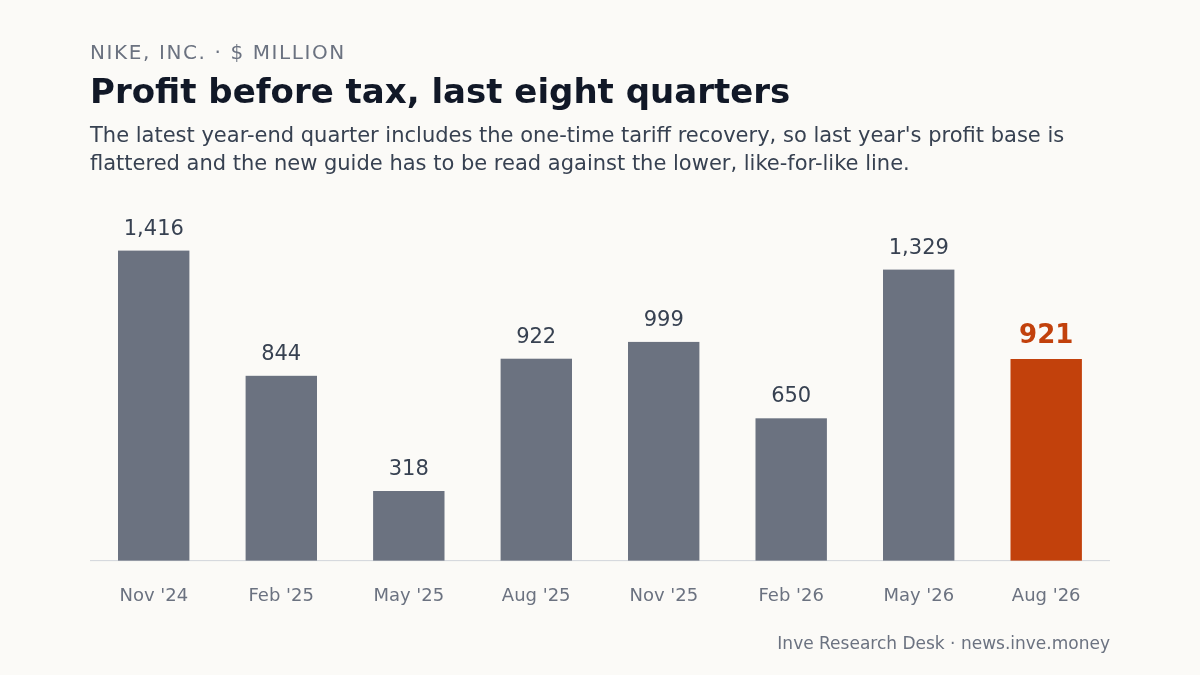
Then the new chief financial officer, David Denton, said Nike would now give a view of the full year, and offered a range: adjusted earnings per share of $1.15 to $1.35. Last year's reported earnings were lifted by a one-time tariff recovery. Without it, Nike said, earnings per share would have been $1.58. Against that figure the new range is 15% to 27% lower, by our arithmetic. That figure also still carries severance cost that the adjusted measure leaves out.
Put both years on the same footing and the gap widens
The two bases differ, so we rebuilt them. Take last fiscal year's pre-tax profit, remove the tariff recovery and add back $385 million of severance cost, per its annual report, and the result is $3.3 billion. By our arithmetic, the new range implies pre-tax profit 19% to 31% lower, assuming a tax rate of a quarter, inside the company's guided band, and the latest share count. The June call put the severance at nearly $400 million, which leaves the gap unchanged, and the October release gives about $0.3 billion, a figure we cannot reconcile with the annual-report one, which would make it 17% to 29%.
Range assumes China worsens; Sportswear, Jordan pressured
Denton said the range assumes China's revenue gets worse over the rest of this fiscal year, as Nike takes actions to reset the marketplace, including clearing out unprofitable online distribution there. In June the company had said China's near-term trend would stay in line with recent performance. Last quarter Greater China revenue fell 26% excluding currency effects, a deeper fall than the quarter before.
Sportswear and Jordan are the other half. In June the company said both would improve in the back half of this fiscal year. On the latest call the chief financial officer said the pressure runs through the rest of the year and will probably spill a little into the next, and the improvement line was not repeated. Meanwhile Nike is deliberately cutting its own supply of Jordan retro and some Sportswear footwear to reset the market.
Sales growth on a year earlier, last eight quarters
Growth has slid from slightly positive to negative over the five most recent quarters, and the full-year guide, revenue down by a high single-digit percentage, has the decline deepening.
Sales YoY, %
- Nov '24 −7.7%
- Feb '25 −9.3%
- May '25 −12.0%
- Aug '25 +1.1%
- Nov '25 +0.6%
- Feb '26 +0.1%
- May '26 −1.1%
- Aug '26 −4.3%
The savings arrive after the profit has fallen
The company's answer is a restructuring programme called Pace: about $2.5 billion of cumulative savings over five years, most of them landing well after this fiscal year. By our arithmetic, this year's like-for-like pre-tax profit falls by roughly a quarter to two-fifths of the whole programme's savings. That sets one year's drop against the savings total, stated before charges and reinvestment, and neither the call nor the release put an amount on the reinvestment.
How last year's annual guides ended: selling and administrative spending, guided to grow by low single digits, grew 0.2%, below guidance; wholesale, guided to return to modest growth, grew 4% excluding currency effects (6% reported, according to Nike's full-year release), meeting guidance; and NIKE Direct, which the company said it did not expect to return to growth, fell, as guided.
What cannot be tested yet
A new finance chief has reason to set a low first bar, and Denton's own description fits: he called the range reasonable and attainable on the information the company has today. That is our reading, not a finding. Charges sit in an excluded adjusted line. The release says Pace builds on the March cost plan, and lists last year's severance separately from Pace's charges; adjusted EPS leaves both out, while last year's base carries the severance.
What we do not know is the gross-margin range, since Denton said the company would probably not guide it, how the savings phase in, since no year-by-year savings were given on the call or in the release, and how much worse China gets. The next tests are the investor day in November and the next quarterly results.
In March Nike said it would return to full-year guidance at the investor day in the fall; it has done so ahead of the November investor day, and the number it chose is the one it will be measured against. What it guides now shows how much room it has left itself.
The record: notes, full financial tables
Notes
Impact 5/5 Guidance Negative
Nike guides FY27 adjusted EPS $1.15-$1.35, under $1.58 it said FY26 earned ex-recovery
New chief financial officer David Denton gave Nike's full-year range: adjusted earnings per share of $1.15 to $1.35, excluding about $0.15 of Pace restructuring cost. Against the $1.58 Nike said fiscal 2026 would have earned without the one-time $986 million tariff recovery ($2.10 reported), that is 15% to 27% lower, by our arithmetic; the $1.58 still carries severance that adjusted EPS leaves out. In June the company said its actions would deliver positive operating leverage and gross margin in fiscal 2027, and that earnings would be flattish through the second quarter of fiscal 2027 excluding the recovery; Denton now said EBIT would fall by a greater percentage than revenue.
“set at a level that we believe is reasonable and attainable based on the information we have today”— David Denton, Chief Financial Officer
Impact 4/5 Guidance Negative
Nike's FY27 guide assumes China gets worse after a 26% currency-neutral fall in Q1
Chief financial officer David Denton said the full-year range builds in a further revenue decline in Greater China as Nike takes actions to reset the marketplace, including clearing out unprofitable online distribution, and that the company will not guide by region. Greater China revenue was $1,180 million in the August 2026 quarter, down 22% reported and 26% excluding currency effects, with EBIT, the company's earnings-before-interest-and-taxes measure, down 34% to $248 million. In the quarter to May 2026 China revenue fell 17% excluding currency effects (12% reported, according to Nike's fourth-quarter release), better than the 31 March guide of down approximately 20%.
“assumes that China actually gets worse from a revenue perspective for the balance of this year”— David Denton, Chief Financial Officer
Impact 4/5 Demand Negative
Nike no longer repeats its back-half improvement call for Sportswear and Jordan; pressure now runs into fiscal 2028
Nike cut revenue from one Sportswear franchise by nearly half, about a $200 million headwind, and will deliberately reduce Jordan retro launches; in the August 2026 quarter Sportswear fell by a low double-digit percentage and Jordan by a mid-teens percentage. In June the company guided both to stay negative this fiscal year with improvement in the back half; the chief financial officer now says the pressure will probably spill a little into fiscal 2028.
“we've been oversupplying our iconic retro product asking them to do too much”— Elliott Hill, Chief Executive Officer
Impact 4/5 Margin Mixed
Nike's Pace targets $2.5B of savings through FY31, mostly after a year of lower profit
Nike said Pace will deliver about $2.5 billion of cumulative savings through fiscal 2031, most in fiscal 2029 and 2030, against about $1.0 billion of pre-tax charges. By our arithmetic, FY27's like-for-like pre-tax profit falls $0.6 billion to $1.0 billion, 25% to 41% of the total savings, a five-year total before charges and reinvestment; the base is fiscal 2026 pre-tax profit less the tariff recovery plus $385 million of severance (the annual-report figure; the June call said nearly $400 million, the October release about $0.3 billion). Nike says it intends to reinvest a portion of the savings; no amount was given on the call or in the release.
“we intend to reinvest a portion of the savings from Pace back into the business with discipline”— David Denton, Chief Financial Officer
Impact 3/5 Balance sheet Mixed
Nike's dividend, $1.64 a year at $0.41 a quarter, is 121-143% of its FY27 adjusted EPS guide; CFO backs it
Asked about the payout, Denton called it a very significant priority and said the five-year financial algorithm would come at the November investor day. At $0.41 a quarter, or $1.64 a year, the payout is 121% to 143% of the $1.15 to $1.35 adjusted guide (adjusted, so before about $0.15 a share of Pace charges), by our arithmetic. First-quarter operating cash flow was $135 million and free cash flow minus $64 million, against about $610 million of dividends; the year-earlier quarter brought $222 million of operating cash flow, and fiscal 2026 brought $2.9 billion, against dividends now running at about $2.4 billion a year, by our arithmetic.
“under all scenarios, we have support for maintaining and ultimately growing the dividend over time”— David Denton, Chief Financial Officer
Financials
Income statement, last 8 quarters
| Quarter end | Sales | YoY | PBT | Net profit |
|---|---|---|---|---|
| Aug 2026 | 11,213 | −4.3% | 921 | 712 |
| May 2026 | 10,972 | −1.1% | 1,329 | 1,069 |
| Feb 2026 | 11,279 | +0.1% | 650 | 520 |
| Nov 2025 | 12,427 | +0.6% | 999 | 792 |
| Aug 2025 | 11,720 | +1.1% | 922 | 727 |
| May 2025 | 11,097 | −12.0% | 318 | 211 |
| Feb 2025 | 11,269 | −9.3% | 844 | 794 |
| Nov 2024 | 12,354 | −7.7% | 1,416 | 1,163 |
Balance sheet
| As of | Equity | Debt | Cash | Fixed assets | Total assets |
|---|---|---|---|---|---|
| Aug 2026 | 15,220 | 7,893 | 6,903 | 4,887 | 37,794 |
| May 2026 | 14,865 | 7,942 | 7,563 | 4,796 | 38,410 |
| Feb 2026 | 14,090 | 8,029 | 6,660 | 4,766 | 37,064 |
| Nov 2025 | 14,085 | 8,015 | 6,974 | 4,843 | 37,787 |
Cash flow
| Year end | Operating | Investing | Financing | Free cash flow |
|---|---|---|---|---|
| May 2026 | 2,868 | −488 | −2,292 | 2,184 |
| May 2025 | 3,698 | −275 | −5,820 | 3,268 |
| May 2024 | 7,429 | 894 | −5,888 | 6,617 |
| May 2023 | 5,841 | 564 | −7,447 | 4,872 |