
Levi Strauss · LEVI
Levi's raised its margin guide on a tariff refund while direct sales slowed to 2.3%
Without a tariff refund that will not recur, Levi Strauss's full-year margin guide is about 11.8% by our arithmetic, lower than July's, and the direct sales channel meant to lead growth grew only 2.3%.
Published · Inve Research Desk

11.8%
full-year margin guide without refund, by our arithmetic
Below the 12% guided in July: the raised 12.1% rests on about 0.3 point of refund that will not recur.
How they did last quarter
Underlying margin came in a little ahead of what the company said, but the profit raise is the refund, and direct sales fell well short of the July yardstick.
- Adjusted EBIT margin15.5%, against 11.8% a year earlier; about 12.2% without the net refund, by our arithmeticvs July guide for the quarter: "leverages approximately 10 basis points to 11.9%"Far above the guide because of the refund; without it, about 0.3 point ahead.
- Direct-to-consumer sales2.3% organic growthvs July guide for the second half: "mid- to high single digits"Below the low end of the range the company set itself.
- Total organic sales4.5% growthvs Guide for the quarter: "up 4% to 5%"Inside the guided range, carried by wholesale rather than direct sales.
- Adjusted SG&A50.8% of sales, against 49.8% a year earliervs 49.8% a year earlierAbout a point heavier, of which about 0.4 point is refund money spent back.
Most of the margin gain is a tariff refund
At its October results call Levi Strauss raised its full-year profit guide to an adjusted EBIT margin of about 12.1%. In the August 2026 quarter the margin was 15.5%, against 11.8% a year earlier, and most of the gain came from a refund of tariffs paid, counted net of what the company chose to spend back.
Net is the operative word. The company is putting most of the refund, about $60 million of roughly $80 million, back into marketing, distribution and promotions: $25 million in the third quarter and about $35 million planned for the fourth. That let it raise the guide and also cover a shortfall in direct sales. Singh put it this way: "tariff refunds were timely. The business, as Michelle mentioned, soften, especially on DTC and women's and we acted with agility and speed".
Without the refund the year guide is a shade lower
Take the refund out and the quarter was about 12.2% by our arithmetic, a little above the company's own guide from July. The full-year figure moved the other way. The new guide holds about 0.3 point of net refund, so the underlying figure is about 11.8% by our arithmetic, below July's guide. The raise is the refund.
Direct sales slowed where growth was meant to come from
In July the company guided direct-to-consumer sales, through its own stores and websites, to a mid-to-high single-digit pace for the rest of the year. They grew 2.3%. The channel is nearly half of sales so the miss matters more than its size. Management blamed warm weather in Europe and a back-to-school campaign built around loose fits just as US buyers moved to low-rise styles, and said September improved.
Total sales growth slowed in each of the last two quarters, though a shift of European shipments between the first and second quarters of last year flattered the 14.1% quarter and held down the one after it, so neither is a clean trend point; adjusted for it, growth still slowed each quarter, to about 11.9% and 10.3% by our arithmetic, then 4.3%. Wholesale did the lifting. The company now guides it to mid-single digits for the year, up from low single digits in April; Singh said July's wording was low to mid.
The fourth-quarter guide is for direct sales to grow at least at a mid-single-digit rate, and for the year at a high single-digit rate. "At least" has no ceiling. By our arithmetic, if high single digit means 7% or more for the year, the fourth quarter has to grow at about that rate, above the mid-single-digit rate guided for the quarter. That rests on our estimate of last year's fourth-quarter direct sales, a base we estimated.
Sales growth on a year earlier, last three quarters
Growth has slowed in each of the last two quarters, from 14.1% to 8.0% to 4.3%: the profit lift did not come from selling much more.
%
| Sales YoY | |
|---|---|
| Mar 2026 | +14.1% |
| May 2026 | +8.0% |
| Aug 2026 | +4.3% |
The distribution saving moved out to next year
Levi's has been moving its US shipping to a third-party operator while running its own centre in parallel. A year ago it expected the parallel running to end early in the year. In July it said it would close the Hebron centre by the end of the quarter, and expected distribution cost in the second half to be better than in the first, mostly in the fourth quarter. Now Hebron has closed, the savings come next year, and this year is the peak of transition cost. Adjusted SG&A, a non-GAAP measure that leaves out restructuring-related charges ($18.8 million this quarter, including some distribution-centre transition costs), rose as a share of sales.
What the next finance chief inherits
Harmit Singh gave his last call as chief financial and growth officer; John Vandemore, most recently CFO of Skechers, succeeds him. Singh was plain about the base. Asked about next year, he said: "Our view is, all in, 12.1, we will lap that going forward. So that's our new base." That base holds some refund that will not recur, so lapping it is a harder hurdle than lapping the underlying figure, by our arithmetic. Singh argued that advertising above its usual share of sales and the duplicate distribution centres will not repeat next year. That is a claim, not a result.
The plan for next year belongs to the chief executive, Michelle Gass, and Vandemore, and is due early in the new year. Singh said it is not complete, and the new team did not say on this call whether it will frame it as he did. The next report will show whether direct sales reached at least mid-single-digit growth in the fourth quarter, and where the margin landed against the guided range.
Given the refund, this company spent $25 million of it back into the business in one quarter and plans more in the next. What it does in a year with no refund is the part still to be seen.
The record: notes, full financial tables
Notes
Impact 5/5 Margin Mixed
Levi's 12.1% margin guide is about 11.8% without the tariff refund, by our arithmetic
Levi Strauss lifted its full-year adjusted EBIT margin guide to about 12.1%, saying the figure holds roughly 0.3 point of net tariff refund. Without it the guide is about 11.8% by our arithmetic, against 12% in July. In the August 2026 quarter the margin was 15.5% against 11.8% a year earlier; 3.3 points of that 3.7-point gain was net refund. Excluding it, the quarter was about 12.2% by our arithmetic, a little above the 11.9% July guide.
“This includes approximately 30 basis points of net tariff refund benefit.”— Harmit Singh, Chief Financial and Growth Officer
Impact 4/5 Demand Negative
Levi's direct sales grew 2.3% against a July guide of mid-to-high single digits
Direct-to-consumer organic sales rose 2.3% in the August 2026 quarter, with Europe hit by warm weather and a back-to-school campaign built around loose fits as US buyers moved to low-rise styles. In July the company guided the channel to mid-to-high single-digit growth. It now guides the fourth quarter to at least mid-single-digit growth and the year to high single digits; by our arithmetic, if high single digit means 7% or more, the year needs a fourth quarter near 7% (nine months grew 7.1%); a fourth quarter at 5% would give about 6.5%, on our estimate of last year's fourth-quarter base.
“DTC will return to at least mid-single-digit growth in the fourth quarter and deliver high single-digit growth for the full year.”— Michelle Gass, President and CEO
Impact 3/5 Margin Negative
Levi's US distribution saving slips to 2027; adjusted SG&A up a point to 50.8% of sales
Levi Strauss closed its Hebron distribution centre at the end of the August 2026 quarter, but now expects the savings in 2027 and describes this year as the peak of transition cost. Adjusted SG&A, a non-GAAP measure that leaves out restructuring-related charges ($18.8 million this quarter, including some distribution-centre transition costs), was 50.8% of sales against 49.8% a year earlier; about 0.4 point of the rise is refund money spent back, and the release attributes the rest mainly to selling and distribution expenses. In July the company expected distribution cost in the second half to be about 0.5 point better than in the first, mostly in the fourth quarter.
“2026 let's call it, the peak of what has been our transition-related costs”— Michelle Gass, President and CEO
Impact 3/5 Demand Positive
Levi's wholesale guide moves to mid-single digits; Q4 growth seen a little slower
Wholesale sales grew 6.3% excluding currency in the August 2026 quarter ($882.3 million against $829.7 million), and the company now guides full-year wholesale growth to mid-single digits. In April it guided to low single digits; Singh said July's wording had been low to mid, though neither the July call nor the July release gave a full-year wholesale figure. Management said fourth-quarter wholesale growth will step down from the third, which Singh said reflects the ebb and flow of customer order timing rather than weaker demand, and that European pre-bookings for spring and summer 2027 are up high single digits.
“wholesale in quarter 4 will be a little weaker than the wholesale you saw in quarter 3 in terms of growth year-over-year”— Harmit Singh, Chief Financial and Growth Officer
Impact 3/5 Risk Mixed
Levi's CFO Singh gives his last call; Vandemore, from 1 November, inherits a 12.1% base
Michelle Gass said John Vandemore, most recently chief financial officer of Skechers, will be the next CFO, and Harmit Singh called this his final call. On 7 April the company announced Singh would retire, began a search for a successor, and said he would stay as CFO until one was appointed and then serve as an adviser. Singh said the company will lap the reported 12.1% full-year margin, which includes about 0.3 point of refund, and that the 2027 plan belongs to the new team, due early next year.
“Our view is, all in, 12.1, we will lap that going forward. So that's our new base.”— Harmit Singh, Chief Financial and Growth Officer
Impact 2/5 Balance sheet Positive
Levi's plans a $100 million accelerated buyback after a refund-aided quarter
Levi Strauss intends to buy back another $100 million of Class A shares through an accelerated repurchase, after a $200 million programme begun in the first quarter settled in the August 2026 quarter. Cash was $641.4 million on 30 August 2026, down from $849.3 million three months earlier, with long-term debt of $1,043.6 million; the release's nine-month cash flow shows $179.7 million of net foreign-exchange forward settlement payments, and it reports $61.6 million of dividends paid in the quarter. Operating cash flow for nine months was $585.2 million against $262.8 million a year earlier, including discontinued operations.
“we intend to repurchase an additional $100 million of shares through an accelerated share repurchase program”— Harmit Singh, Chief Financial and Growth Officer
Financials
Income statement, last 8 quarters
| Quarter end | Sales | YoY | Operating profit | Op. margin | PBT | Net profit |
|---|---|---|---|---|---|---|
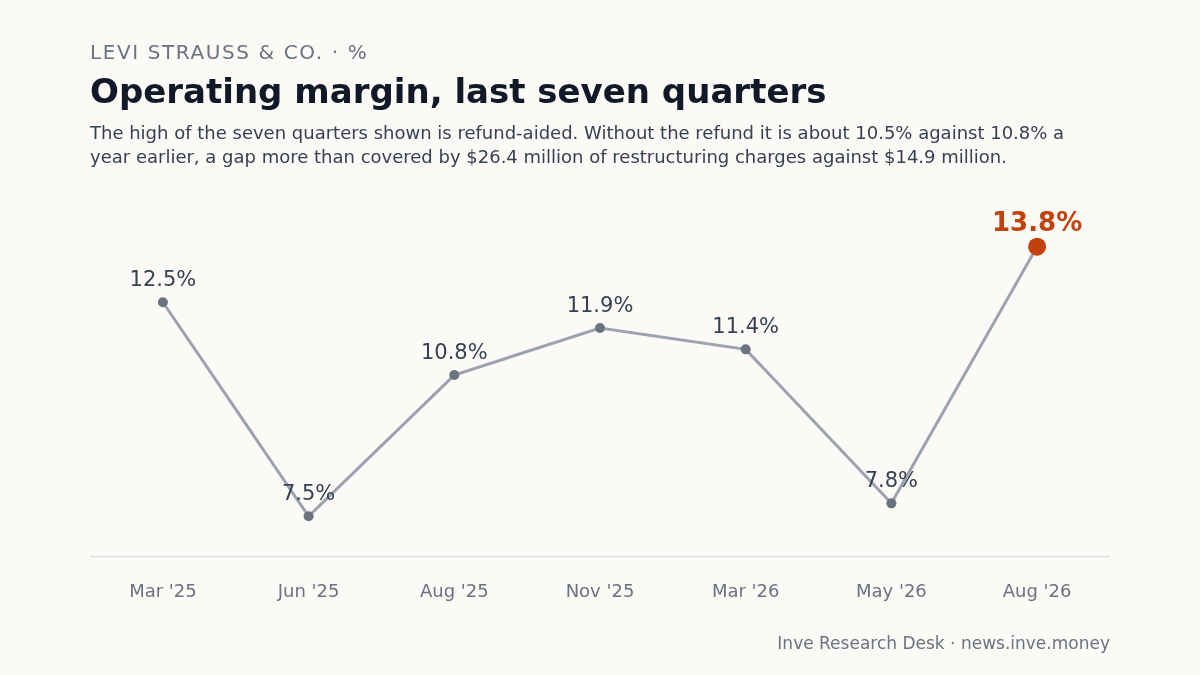
| Aug 2026 | 1,610 | +4.3% | 222 | 13.8% | 220 | – |
| May 2026 | 1,562 | +8.0% | 122 | 7.8% | 122 | – |
| Mar 2026 | 1,743 | +14.1% | 199 | 11.4% | 228 | – |
| Nov 2025 | 1,766 | −4.0% | 211 | 11.9% | 199 | – |
| Aug 2025 | 1,543 | +7.0% | 167 | 10.8% | 156 | – |
| Jun 2025 | 1,446 | +6.4% | 108 | 7.5% | 103 | – |
| Mar 2025 | 1,527 | +3.1% | 192 | 12.5% | 177 | 135 |
| Dec 2024 | 1,840 | +12.0% | 212 | 11.5% | 200 | 183 |
Balance sheet
| As of | Equity | Debt | Cash | Investments | Fixed assets | Total assets |
|---|---|---|---|---|---|---|
| Aug 2026 | 2,415 | 1,044 | 641 | 138 | 656 | 6,929 |
| May 2026 | 2,272 | 1,043 | 849 | 129 | 660 | 6,628 |
| Mar 2026 | 2,207 | 1,049 | 717 | 95 | 669 | 6,575 |
| Nov 2025 | 2,279 | 1,039 | 758 | 91 | 682 | 6,849 |
Cash flow
| Year end | Operating | Investing | Financing | Free cash flow |
|---|---|---|---|---|
| Nov 2025 | 530 | −69 | −400 | 308 |
| Dec 2024 | 898 | −281 | −319 | 671 |
| Nov 2023 | 436 | −241 | −214 | 122 |
| Nov 2022 | 228 | −236 | −365 | −39 |