
Lamb Weston Holdings · LW
Lamb Weston raised its profit guidance by the size of its beat and left the rest of the year's ask alone
Lamb Weston lifted its adjusted EBITDA guidance by about the amount the quarter beat its guidance, while the three quarters still to come need about the same profit as in July, against higher inflation.
Published · Inve Research Desk
Lamb Weston Holdings stock page → More news from Oct 10, 2026

$884.4M
adjusted EBITDA still needed in Q2-Q4, by our arithmetic
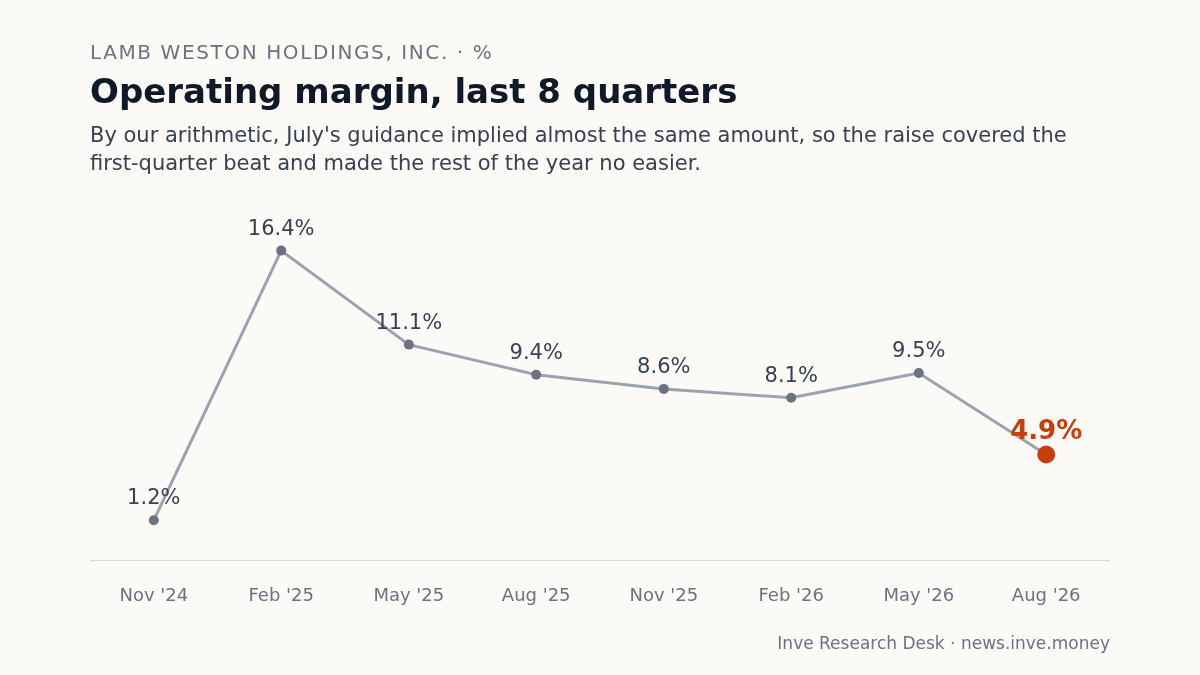
By our arithmetic, July's guidance implied almost the same amount, so the raise covered the first-quarter beat and made the rest of the year no easier.
How they did last quarter
Better than the company said for the quarter, which is why the guidance rose, while International profit and operating cash flow were weaker than a year ago.
- Adjusted EBITDA$285.6M, down 5.5% from $302.2M a year agovs July guidance of adjusted EBITDA "to decline in the low teens" (our reading: $259.9-269.0M)Ahead of the guidance by about $17-26M, which is what the raise passes through.
- Net sales$1,670.3M, up 0.7% on a year agovs $1,659.3M a year agoAlmost level: volume up 2.2% was largely offset by price/mix down 1.8%.
- International adjusted EBITDA$26.5M, down 54% from $57.2M a year ago, up from $11.8M in the quarter beforevs July guidance that "International segment EBITDA is anticipated to improve between 40% and 50%" for the yearWell below a year ago, yet in line with the company's expectations; in July the company said Q1 would carry the most potato-crop and edible-oil carryover, company-wide.
- Operating cash flow$234.8M, down 33% from $352.0M a year agovs a year agoLower: year-ago was helped by a $136M inventory release; this quarter by $59.2M from payables.
The raise is about the size of the beat
Lamb Weston raised its guidance for adjusted EBITDA, its own measure of operating profit before depreciation and one-off items. The reason is easy to see. In July the company said adjusted EBITDA in the August 2026 quarter would fall in the low teens, in percentage terms. It fell, to $285.6 million. By our reading of that wording, the quarter beat the guidance.
The full-year range moved up, and its midpoint rose by $20 million. That is about the size of the beat. The raise passes one good quarter through to the year. It says nothing new about the other three.
The ask for the rest of the year did not ease
Subtract the quarter already earned from the new midpoint and $884.4 million is left for the other three quarters, by our arithmetic. In July the same sum gave almost exactly the same amount. So the work still to be done did not shrink when the guidance went up.
That is growth of about 8% on the comparable quarters of last year, by our arithmetic, after a quarter in which the measure fell. The chief financial officer also said "we're about 100 basis points higher on our inflation expectation for the year." Basis points are hundredths of a percentage point, so the unchanged ask has to absorb more input inflation outside potatoes.
Last year's record favours management, up to a point
The company has last year on its side. Last fiscal year closed above the top of its April guidance on both net sales and adjusted EBITDA, and that guidance already included the extra week in the year. So the extra week did not cause the beat.
That is a single fiscal year of guidance and results, the one just closed. The year before, the company cut its fiscal 2025 adjusted EBITDA target in December 2024 to $1.17-1.21 billion, from around $1.38 billion, the low end of its $1.38-1.48 billion range. A partly new team set July's guidance: the chief financial officer took the role in April and the executive chair joined in February, though the chief executive, Mike Smith, also led the company when the April guidance was set, and one quarter's beat against it says little about the other three. Passing the beat through is sensible. It is also the part that costs nothing.
International and Europe are where the plan is untested
In July the company guided International profit to rise 40% to 50% this year. Last quarter it fell by more than half from a year ago, though that was up on the quarter before. The company said the quarter was in line with its expectations, and in July it had said the first quarter would feel the most carryover from last year's potato crop and from edible oil inflation, company-wide. By our arithmetic, the old target needed each of the remaining three quarters to run well above last quarter's level.
The company did not repeat that target in the release or on the call. Adding to an answer on European potato supply, the chief financial officer spoke of "a little bit more of a kind of a balanced view for international versus the full year guide that we had". Not repeating a target is not the same as dropping it, and the company deferred the long-term question to an investor day.
Europe adds a second unknown. Management said the potato crop there is smaller after heat and dry weather, that it has enough contracted-price potatoes with a small open portion whose higher cost is already in its forecast, and that its price increase "seems to be pretty understood by our customers". Whether prices stick will show in price/mix in coming quarters.
The adjusted number leaves a good deal outside it
Most of the fall in reported operating income comes from larger add-backs: the company's reconciliation adjusts operating income by $95.4 million this quarter against $50.0 million a year ago, and the $95.4 million is a third of adjusted EBITDA. The one new item is a legal accrual, which the quarterly filing ties in part to an Oregon class action over nitrate levels in groundwater, headed for trial.
Cash tells a similar story. Operating cash flow fell by a third, and payables, helped by better supplier terms, supplied part of what remained. The year-ago quarter was itself helped by a release of inventory, which the company cites first in explaining the fall, along with a fall in reported net income; with payables and inventory both set aside, by our arithmetic, the quarter was $174.1 million against $263.4 million. By our reading, a gain from better terms recurs only if terms keep improving. The company left its cash guidance unchanged while raising its earnings guidance.
Operating and free cash flow, fiscal years
Free cash flow rose from minus $131.3 million in fiscal 2024 to $540.2 million in fiscal 2026; the weaker first-quarter cash figure tests whether that holds.
$ million
| Operating cash flow | Free cash flow | |
|---|---|---|
| May 2023 | 762 | 108 |
| May 2024 | 798 | −131 |
| May 2025 | 868 | 230 |
| May 2026 | 943 | 540 |
The second quarter is the next test
The company guided second-quarter adjusted EBITDA up by high single to low double digits. That is the next piece of the raised plan that a result will test.
A company that raises its guide by about the size of its beat has told you what it knows, and said nothing about what it hopes.
Lamb Weston Holdings stock page →
The record: notes, full financial tables
Notes
Impact 5/5 Guidance Mixed
Lamb Weston lifts FY27 EBITDA guide by $20M, about the size of its Q1 beat
The company raised its fiscal 2027 adjusted EBITDA guidance to $1.125-1.215 billion from $1.10-1.20 billion, up $20 million at the midpoint. Adjusted EBITDA was $285.6 million in the August 2026 quarter, down 5.5% from $302.2 million but ahead of July's guidance of a decline in the low teens (our reading: 11% to 14%), a beat of $16.6-25.7 million. By our arithmetic the last three quarters still need $884.4 million, against about $885.6 million implied in July. The chief financial officer said non-potato input cost inflation is now expected about one percentage point higher for the year.
“we're about 100 basis points higher on our inflation expectation for the year.”— James Gray, Chief Financial Officer
Impact 4/5 Guidance Negative
Lamb Weston International EBITDA falls 54% to $26.5M; 40-50% target not repeated
International segment adjusted EBITDA was $26.5 million in the August 2026 quarter, down 54% from $57.2 million a year ago but up from $11.8 million in the quarter before; the company said the quarter was in line with its expectations. In July the company guided the segment's profit up 40% to 50% for the year; that target was not repeated in the release or on the call. By our arithmetic the old target needed $43-47 million a quarter for the remaining three, roughly 60% to 75% above last quarter's level.
“a little bit more of a kind of a balanced view for international versus the full year guide that we had.”— James Gray, Chief Financial Officer
Impact 3/5 Risk Mixed
Lamb Weston says European potato tonnage is down 15-20% and raises prices there
The chief executive said Lamb Weston implemented a price increase in Europe earlier in October and that, by his account, it seems customers understand it, while European crop tonnage is down about 15% to 20% after heat and dry weather. Management said it has enough contracted-price potatoes, with a small open portion whose higher cost is already in its forecast; in July it had counted on lower raw potato costs to help fiscal 2027 operating income. International price/mix was down 2.0% in the August 2026 quarter, before the increase. Realised pricing is not yet reported, so whether prices hold will show in coming quarters' price/mix.
“we've implemented an increase in Europe. And that seems to be pretty understood by our customers.”— Mike Smith, President and CEO
Impact 3/5 Margin Positive
Lamb Weston North America EBITDA up 11%; about 6% excluding tariff refund and JV swing
North America adjusted EBITDA rose 10.5% to $287.3 million in the August 2026 quarter from $260.0 million. Removing a $5 million tariff refund and the $6.8 million year-on-year swing in joint-venture earnings ($6.2 million against a loss of $0.6 million), by our arithmetic, leaves $275.5 million, up 6.0%. Price/mix was down 1.7%, better than 2.4% in the quarter before, and on price/mix the chief financial officer said the drag is easing. That first quarter sits above the July full-year range of flat to up low single digits.
“we see that becoming less and less of a headwind and possibly a contributor.”— James Gray, Chief Financial Officer
Impact 3/5 Balance sheet Mixed
Lamb Weston operating cash flow falls 33% to $234.8M; cash guidance unchanged
Operating cash flow was $234.8 million in the August 2026 quarter, down from $352.0 million a year ago, which had a $136 million inventory release that the company cites first in explaining the fall, along with a $35 million drop in reported net income. This quarter had $59.2 million from payables, without which, by our arithmetic, it was $175.6 million, against payables of minus $47.7 million a year ago. The company left fiscal 2027 operating cash flow guidance at $750-800 million and cash capex at $380-410 million. Last year cash capex came in at $410 million, against the April estimate of about $400 million.
“We expect to hold the investment in working capital relatively flat year-over-year despite an anticipated increase in net sales.”— James Gray, Chief Financial Officer
Impact 3/5 One-off Negative
Lamb Weston adds back $33.0M legal accrual; Oregon class action trial set for 2027
Adjusted EBITDA and adjusted EPS exclude a $33.0 million accrual for legal proceedings and other claims, worth $0.18 a share after tax, which the 10-Q filed the same day says includes the company's best estimate of probable loss in an Oregon class action over nitrate levels in groundwater, set for trial in September 2027. A separate U.S. antitrust class action was allowed to proceed to discovery on 17 September 2026, and the company says it cannot predict the outcome or estimate the range of potential loss. By our sum of the release's reconciliation, total add-backs were $95.4 million, a third of adjusted EBITDA, against $50.0 million a year earlier.
Financials
Income statement, last 8 quarters
| Quarter end | Sales | YoY | Operating profit | Op. margin | PBT | Net profit |
|---|---|---|---|---|---|---|
| Aug 2026 | 1,670 | +0.7% | 82 | 4.9% | 40 | 29 |
| May 2026 | 1,770 | +5.6% | 169 | 9.5% | 121 | 110 |
| Feb 2026 | 1,565 | +2.9% | 127 | 8.1% | 82 | 54 |
| Nov 2025 | 1,618 | +1.1% | 139 | 8.6% | 95 | 62 |
| Aug 2025 | 1,659 | +0.3% | 157 | 9.4% | 113 | 64 |
| May 2025 | 1,676 | +4.0% | 186 | 11.1% | 142 | 120 |
| Feb 2025 | 1,521 | +4.3% | 249 | 16.4% | 201 | 146 |
| Nov 2024 | 1,601 | −7.6% | 19 | 1.2% | −25 | −36 |
Balance sheet
| As of | Equity | Debt | Cash | Fixed assets | Total assets |
|---|---|---|---|---|---|
| Aug 2026 | 1,807 | 3,858 | 166 | 3,619 | 7,323 |
| May 2026 | 1,825 | 3,845 | 68 | 3,690 | 7,380 |
| Feb 2026 | 1,827 | 3,912 | 58 | 3,653 | 7,394 |
| Nov 2025 | 1,754 | 3,836 | 83 | 3,653 | 7,331 |
Cash flow
| Year end | Operating | Investing | Financing | Free cash flow |
|---|---|---|---|---|
| May 2026 | 943 | −380 | −569 | 540 |
| May 2025 | 868 | −648 | −225 | 230 |
| May 2024 | 798 | −984 | −48 | −131 |
| May 2023 | 762 | −1,341 | 341 | 108 |