
Johnson & Johnson · JNJ
J&J raised its 2026 guide, but $1.36 a share of 2027 deal charges leaves earnings growth thin
Johnson & Johnson lifted its 2026 sales and earnings guidance in small steps, while the deal charges it disclosed mean, by our arithmetic, adjusted earnings per share could barely grow in 2027.
Published · Inve Research Desk

$1.36
deal charge per share in 2027, against $0.64 in 2026
By our arithmetic, adjusted earnings per share stays near this year's level next year unless growth without the deals tops about 6%, if the Sail option is exercised as the company assumes.
How they did last quarter
Sales held steady and adjusted earnings fell on deal charges, with MedTech slowing from the quarter before.
- Sales$25,399 million, +6.0% operationalvs 5.6% operational in the quarter beforeA modest pick-up on the quarter before.
- Adjusted EPS$2.59vs $2.80 a year ago, down 7.5%Acquired research for two deals is counted inside the adjusted figure.
- GAAP EPS$0.09vs $2.12 a year agoThe release attributes the fall to a one-time charge for the proposed talc resolution, which the call puts at $5.5 billion, and the two deals.
- MedTech sales+2.5% operationalvs +3.6% in the quarter beforeSlower, after management pointed to an improvement in the second half.
A raise of $100 million on a $100 billion year
Johnson & Johnson raised the midpoint of its operational sales guidance for the year by that amount, the smallest of three raises since the January guide. The adjusted earnings guide is six cents above the 29 July update, which had already absorbed the deal charges.
Take out the extra week and the fourth quarter is no faster
The year has an extra week, which the company puts at one percentage point of growth. Take it out and the fourth quarter needs about 5.7% underlying growth, against 6.0% last quarter, by our arithmetic.
That is steadiness. The chief executive called this year one of accelerated growth. The fourth-quarter figure the guide implies, taking out the extra week, is slightly below the third quarter's. The extra week will lift the fourth quarter's reported growth, but not the underlying pace.
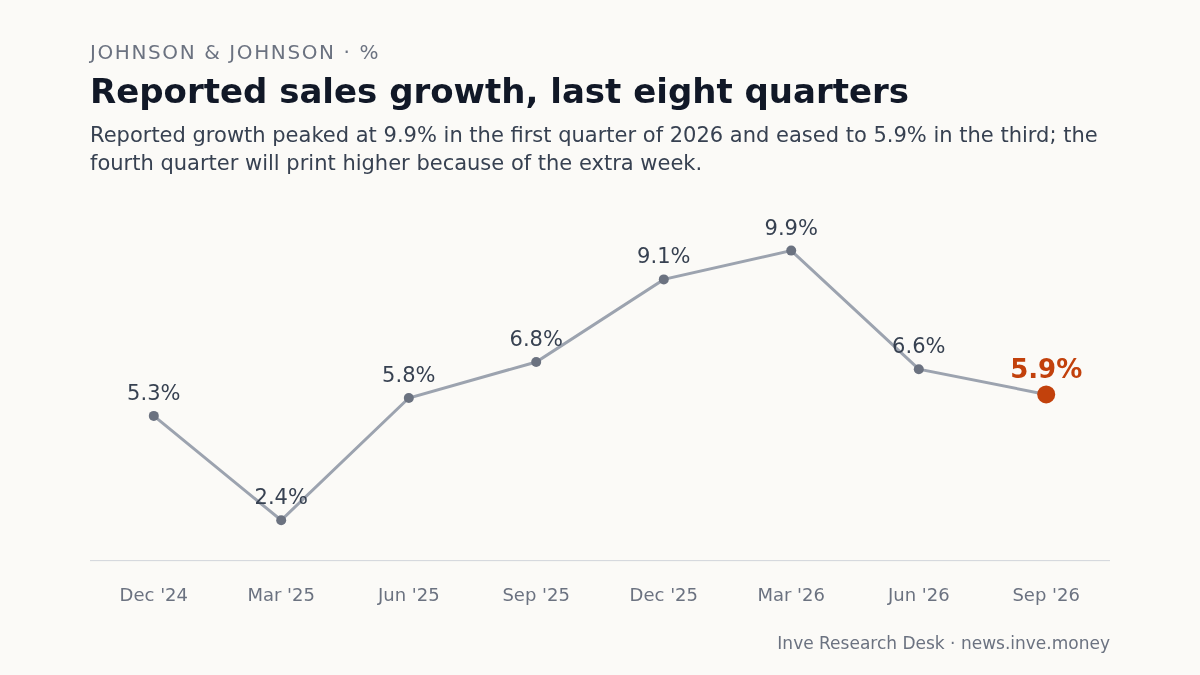
Adjusted earnings grow far slower than sales
Adjusted earnings per share fell last quarter, with the adjusted measure still counting the price of acquired research for the Firefly Bio and Sail Biomedicines deals. The company puts the guidance midpoint at growth of 2.9% for the year. That compares with operational sales growth of 6.7% to 7.1% in the same guide. With the $0.64 these deals cost this year added back, management said growth would approach 9%.
Next year starts with a bigger charge
In his prepared remarks, the chief financial officer gave the deal cost as "a combined dilutive impact of $1.36 per share on a full year adjusted earnings per share next year". Of that, about $1.28 comes from Sail and the rest from Firefly, and the company's 29 July filing, where J&J first gave the charge, says the Sail part assumes Sail reaches certain development milestones and that J&J exercises its option, which would cost a further $2.58 billion. By our arithmetic, for adjusted earnings merely to match this year's, earnings without the deals must grow 6.1%. The chief financial officer said earnings growth typically runs a little better than sales growth once that charge is adjusted for, and an analyst, Larry Biegelsen, citing the chief financial officer's earlier Deutsche Bank remarks, put next year's reported sales growth at about 5.4%, which the chief financial officer did not dispute on the call. So by our arithmetic, ex-deal growth near 6% leaves next year's adjusted earnings per share about where this year's are, a little under or a little over level across the range we ran. The company has set 8 December for its outlook, where the chief financial officer said the company would probably give a pro forma for the orthopaedics separation that could move next year's base.
MedTech's first second-half quarter fell short of July
In July management said MedTech should improve in the second half. Instead it grew 2.5% last quarter against 3.6% the quarter before, and the head of MedTech called the result below the expectations previously communicated to investors. Innovative Medicine accelerated, but by our arithmetic most of that gain is a smaller drag from Stelara.
What we do not know yet
Talc is a large unknown turned into a number. The company agreed to resolve ovarian talc claims for $5.5 billion, conditional on 95% of remaining claims taking part, and said it is trending to meet that threshold. In January the chief financial officer said it would keep aggressively fighting claims it called meritless.
Two growth stories are harder to check. In January the company expected milvexian data for atrial fibrillation in the same year; in July the research head called the studies event-driven and said the readout could come at the end of this year or the start of next; the study is now placed next year. Asked for sales of Icotyde, the company said it had disclosed none and would do so next year.
Management gave this year's growth both with and without the deals, and gave next year as a charge to be subtracted and a rule of thumb, not a number. The version a holder owns has the charges in it.
Johnson & Johnson stock page →
The record: notes, full financial tables
Notes
Impact 4/5 Guidance Negative
J&J puts 2027 deal charges at $1.36 a share, against $0.64 in 2026
The chief financial officer said the Firefly Bio acquisition and Sail Biomedicines collaboration cut adjusted earnings per share by $0.64 in 2026 and will cut it by $1.36 in 2027; about $1.28 is Sail and $0.08 Firefly, and the 29 July filing, first given there, says the Sail part assumes Sail meets development milestones and J&J exercises its option, costing $2.58 billion more. Adjusted EPS guidance for 2026 is now $11.05 to $11.15, which the company puts at 2.9% above 2025's $10.79 at the midpoint. On 15 July 2026, before the deal charges, the midpoint was $11.68. The 2027 outlook is due at an 8 December 2026 enterprise business review.
“a combined dilutive impact of $1.36 per share on a full year adjusted earnings per share next year”— Joseph Wolk, Chief Financial Officer
Impact 4/5 Guidance Mixed
J&J lifts 2026 sales guide $100M to $100.7B; Q4 needs no extra speed
J&J raised the midpoint of 2026 operational sales guidance to $100.7 billion, growth of 6.7% to 7.1%, from $100.6 billion on 15 July 2026. Removing the extra week, which the company puts at one percentage point, the fourth quarter needs about 5.7% underlying growth by our arithmetic, against 6.0% last quarter. The adjusted pretax margin guide is now a decline of about 0.6 percentage points, from 0.75 in the 29 July 2026 update; the chief financial officer said the 29 July figure included 150 basis points from the Firefly Bio and Sail Biomedicines deals and that, without them, the base margin still improves.
“we are raising the midpoint and tightening the range of our operational sales guidance”— Joseph Wolk, Chief Financial Officer
Impact 4/5 Demand Negative
J&J MedTech grew 2.5%, 0.1% outside the US, after July's call for improvement
MedTech sales grew 2.5% operationally to $8.6 billion last quarter, with the United States up 4.8% and the rest of the world up 0.1%. The quarter before it grew 3.6%, and on 15 July 2026 management said it expected improvement in the second half. Surgery fell 1.0% and Abiomed 1.5%; management cited China procurement policy and Middle East disruption, which it called deferred rather than lost.
“While we fell short of our expectations for this segment our conviction in our future direction has not changed.”— Joaquin Duato, Chairman and Chief Executive Officer
Impact 4/5 Risk Mixed
J&J books a $5.5 billion proposed ovarian talc resolution; GAAP net earnings fall to $210M
J&J said it has agreed to resolve ovarian talc litigation for $5.5 billion, conditional on enough claimants taking part, and is trending to meet the threshold. GAAP net earnings were $210 million last quarter against $5,152 million a year earlier. On 21 January 2026 the chief financial officer said it would keep aggressively fighting claims it called meritless. The release says GAAP EPS reflects a one-time special charge for the proposed resolution, while adjusted EPS excludes special items.
“The agreement is conditioned upon the express participation of at least 95% of the remaining ovarian claims.”— Joseph Wolk, Chief Financial Officer
Impact 3/5 Guidance Negative
J&J puts milvexian atrial fibrillation data in 2027, after January's 2026 expectation
John Reed, head of Innovative Medicine research, said the milvexian atrial fibrillation study, the larger population, will read out next year, with secondary-stroke data perhaps this year. On 21 January 2026 the company expected both readouts later in 2026 and called milvexian a $5 billion-plus asset. On 15 July 2026 Reed called the studies event-driven and said the readout could come at the end of 2026 or the start of 2027, with no firm date. He said he remained confident.
“The atrial fibrillation, the larger population will be next year.”— John Reed, EVP, Innovative Medicine Research and Development
Impact 3/5 Demand Mixed
J&J gave no Icotyde sales on the call; Inlexzo sales north of $90M, slower growth
More than 20,000 patients have started Icotyde, up from 11,000 on 15 July 2026, but asked for sales an executive said none were disclosed and they would be next year. Inlexzo sales were north of $90 million last quarter against $30 million in the first quarter; if the third quarter was $90 million to $95 million, the second quarter was about $70 million to $80 million and sales grew roughly 13% to 36% on the quarter before, by our arithmetic, after more than doubling in the second quarter, as the company said on 15 July 2026.
Financials
Income statement, last 8 quarters
| Quarter end | Sales | YoY | PBT | Net profit |
|---|---|---|---|---|
| Sep 2026 | 25,399 | +5.9% | – | 210 |
| Jun 2026 | 25,310 | +6.6% | 6,747 | 5,534 |
| Mar 2026 | 24,062 | +9.9% | 5,990 | 5,235 |
| Dec 2025 | 24,564 | +9.1% | 4,966 | 5,116 |
| Sep 2025 | 23,993 | +6.8% | 7,493 | 5,152 |
| Jun 2025 | 23,743 | +5.8% | 6,491 | 5,537 |
| Mar 2025 | 21,893 | +2.4% | 13,631 | 10,999 |
| Dec 2024 | 22,520 | +5.3% | 3,887 | 3,431 |
Balance sheet
| As of | Equity | Debt | Cash | Investments | Fixed assets | Total assets |
|---|---|---|---|---|---|---|
| Jun 2026 | 84,971 | 49,036 | 20,422 | 336 | 23,582 | 201,061 |
| Mar 2026 | 81,186 | 54,987 | 21,688 | 363 | 23,270 | 200,894 |
| Dec 2025 | 81,544 | 47,938 | 19,709 | 393 | 23,169 | 199,210 |
| Sep 2025 | 79,277 | 45,795 | 18,231 | 331 | 22,338 | 192,816 |
Cash flow
| Year end | Operating | Investing | Financing | Free cash flow |
|---|---|---|---|---|
| Dec 2025 | 24,530 | −23,588 | −5,539 | 19,698 |
| Dec 2024 | 24,266 | −18,599 | −3,132 | 19,842 |
| Dec 2023 | 22,791 | 878 | −15,825 | 18,248 |
| Jan 2023 | 21,194 | −12,371 | −8,871 | 17,185 |