Eicher Motors · EICHERMOT
Royal Enfield now expects its next Cheyyar module in early 2027 as bookings outrun supply
Eicher Motors said a second Cheyyar production module was due between January and March 2027 to lift Royal Enfield's capacity, while the operating margin slipped and management declined to give an outlook for it.
4 min read Published on

Published by
Inve Content team
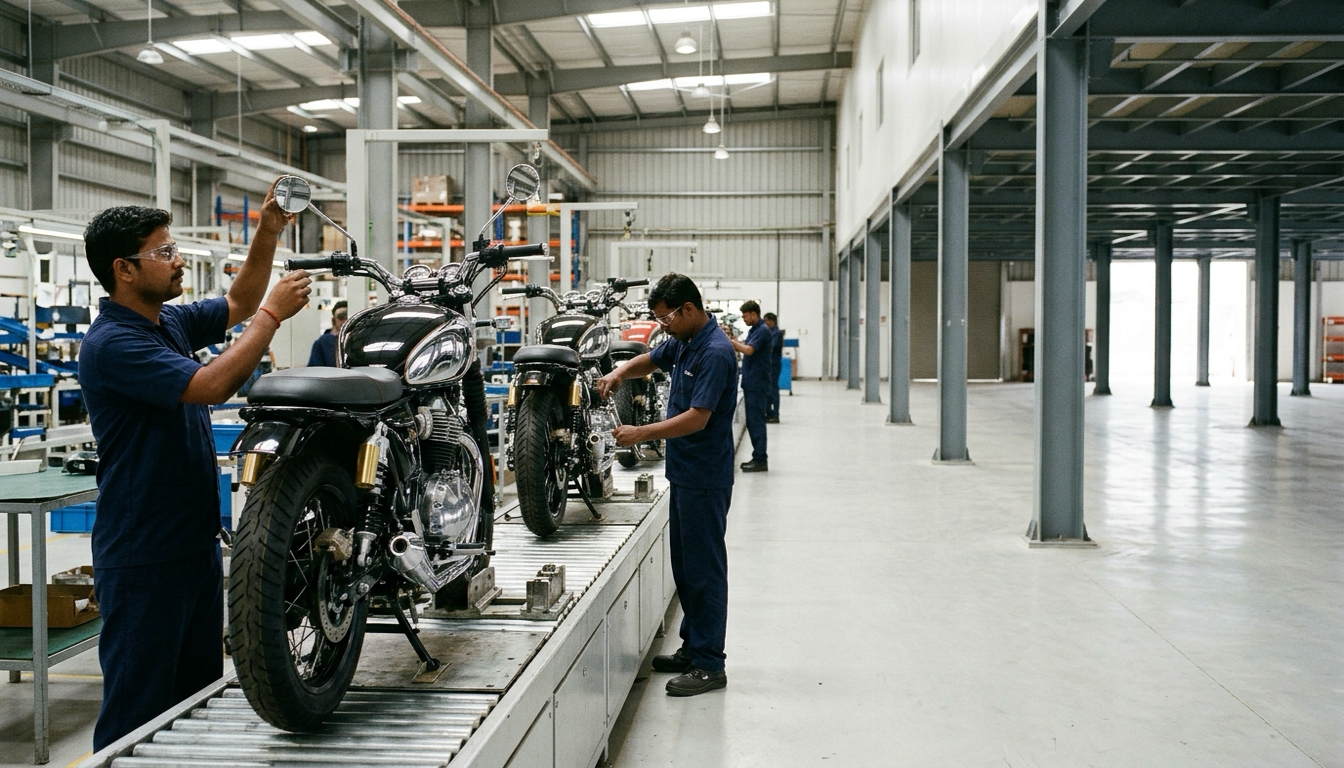
Royal Enfield's next block of motorcycle capacity is now due in the first three months of 2027. On 13 November, when Eicher Motors reported results for the September 2026 quarter, B. Govindarajan, its managing director and the chief executive of Royal Enfield, said the second of three new production modules at its Cheyyar plant in Tamil Nadu, originally meant for a later date, had been brought forward. "We are preponing that, and we will get it by Q4 of FY 2027, which will take the capacity to 1.8 million per year," he said. That sits awkwardly with what he said on 4 August, when he expected the next Cheyyar module by the first week of October: if that was the same second module, the new date of January to March 2027 is a quarter or more after the one given in August, not before it. The financial year ends in March 2027, so the extra lines would be running for the start of the next one.
The reason for pressing on capacity is that, by management's account, the factories rather than the customers now set the pace. Govindarajan said retail sales in the festive season were held back only by what the company could supply, and that stock with dealers after Diwali was down to about a week, counting bikes in transit, against 10 to 12 days at the August results. He put bookings this year at 20% to 21% above 2025. Consolidated revenue rose 20% from a year earlier.
Not everyone on the call accepted the supply-limited picture. Joseph George, an analyst at IIFL Capital, compared the company's domestic shipments to dealers from April to October with government vehicle registrations over the same months: "Effectively, retails are trailing wholesales by about 55,000 or so." A gap of that size is hard to square with a week of dealer stock. Govindarajan replied that the company's own registration tally showed no such difference and that it would check again. The bookings, the dealer stock and the shortage are management's figures, and the question was left open.
What can be tested is the capacity record. In July 2025 the company put capacity at 1.2 million bikes a year, most of it already in use. In May 2026 it said a new module would lift capacity to more than 1.6 million from June and July; by September capacity had reached 1.65 million, after the first Cheyyar module started production between July and September. The later steps are unchanged guidance: the third Cheyyar module in time for the 2027 festive season, and more after a new plant at Tada in Andhra Pradesh, which the company expects to finish by 2029-30.
Royal Enfield's capacity reached 1.65 million by September; the rest of the plan is still guidance
million a year
Royal Enfield capacity
- 1.2 million Jul 2025
- 1.65 million Sep 2026
- 1.8 million Plan: Q4 FY27
- 2 million Plan: Q2 FY28
- 2.45 million Plan: FY30
The extra bikes have come with a thinner margin. Operating profit, measured before depreciation, was 23.7% of sales last quarter, below a year earlier and lower than in the two quarters before it. Vidhya Srinivasan, the chief financial officer, said the company raised prices again in October, and Govindarajan said price increases had covered about half of the rise in commodity costs. Asked whether the margin had found its level, Srinivasan said: "we don't give forward-looking guidances, okay? So I cannot really talk about it." Govindarajan repeated that the percentage is not what drives the company, the same preference for absolute profit and growth that he set out in July 2025.
The operating margin has eased over the last three quarters as Royal Enfield built more bikes
%
Operating margin
- 24.5% Q2 FY26
- 25.5% Q3 FY26
- 24.9% Q4 FY26
- 24.0% Q1 FY27
- 23.7% Q2 FY27
The factories themselves are not costly for a company of this size. Govindarajan now puts the Cheyyar budget at about ₹1,050 crore for its three modules, more than it gave when the expansion was announced in February. Adding the board's approval for the first phase of Tada, the two projects together come to less than half of the cash the business generated from operations in the year to March 2026, and the company held far more than that in investments at the end of September, with little borrowing.
The Cheyyar expansion and Tada's first phase together cost less than half of one year's operating cash flow
₹ cr
- Cheyyar, three modules ₹1,050 crore
- Tada, phase 1 ₹1,225 crore
- Cash from operations, FY26 ₹4,805 crore
- Investments, 30 Sep 2026 ₹16,322 crore
The record: full financial tables
Financials
Income statement, last 8 quarters
| Quarter end | Sales | YoY | Operating profit | Op. margin | Other income | PBT | Net profit |
|---|---|---|---|---|---|---|---|
| Sept 2026 | 7,422 | +20.3% | 1,760 | 23.7% | 518 | 1,992 | 1,573 |
| Jun 2026 | 6,632 | +31.5% | 1,591 | 24.0% | 634 | 1,925 | 1,463 |
| Mar 2026 | 6,080 | +16.0% | 1,514 | 24.9% | 675 | 1,937 | 1,520 |
| Dec 2025 | 6,114 | +22.9% | 1,557 | 25.5% | 465 | 1,793 | 1,421 |
| Sept 2025 | 6,172 | +44.8% | 1,512 | 24.5% | 486 | 1,779 | 1,369 |
| Jun 2025 | 5,042 | +14.8% | 1,203 | 23.9% | 603 | 1,593 | 1,205 |
| Mar 2025 | 5,241 | +23.1% | 1,258 | 24.0% | 628 | 1,669 | 1,362 |
| Dec 2024 | 4,973 | +19.0% | 1,201 | 24.2% | 452 | 1,461 | 1,170 |
Balance sheet
| As of | Equity | Debt | Investments | Fixed assets | CWIP | Total assets |
|---|---|---|---|---|---|---|
| Sept 2026 | 25,941 | 515 | 16,322 | 4,445 | 384 | 34,410 |
| Mar 2026 | 25,100 | 514 | 17,496 | 3,852 | 736 | 32,164 |
| Sept 2025 | 22,086 | 446 | 16,512 | 4,036 | 129 | 28,944 |
| Mar 2025 | 21,296 | 458 | 14,791 | 3,473 | 491 | 27,174 |
Cash flow
| Year end | Operating | Investing | Financing | Free cash flow |
|---|---|---|---|---|
| Mar 2026 | 4,805 | −2,834 | −1,983 | 3,538 |
| Mar 2025 | 3,980 | −2,461 | −1,399 | 2,951 |
| Mar 2024 | 3,724 | −2,834 | −844 | 2,909 |
| Mar 2023 | 2,823 | −2,397 | −417 | 2,149 |