
Tata Consultancy Services · TCS
Management did not repeat the 25% margin goal analysts cite, as TCS growth held at 0.5%, below Q4 FY26's 1.2%
Tata Consultancy Services grew 0.5% in constant currency on the quarter before, below the 1.2% of Q4 FY26, and held its margin at 24% while the finance chief stayed vague on the 25% analysts asked about.
Published · Inve Research Desk
Tata Consultancy Services stock page → More news from 10 Oct 2026

0.5%
constant-currency growth on the quarter before
By the CEO's account, the same pace as the quarter before and below the 1.2% of Q4 FY26; April's guide of a stronger first half named no baseline. Margin held at 24%, given without a decimal.
How they did last quarter
By the CEO's account sequential growth matched Q1 FY27, below the 1.2% of Q4 FY26, though constant-currency revenue rose 2.8% on a year ago and margin ended below Q4 FY26's.
- Constant-currency revenue growth0.5% on the quarter before, 2.8% on a year agovs CEO, 9 April 2026: "We are looking at a regular Q1, regular Q2 that we are used to seeing" and "We are also expecting a stronger 1H. Our planning assumption is along those lines only."By the CEO's account the half ran at about 0.5% a quarter, by our arithmetic, down from 0.8% and 1.2%; the April guide named no number or baseline.
- Operating margin24% as the company gave it, without a decimal, against 25.3% in Q4 FY26vs CFO, 9 April 2026, on the annual pay rise: "which had been in the range of 150 to 200 basis points"By our arithmetic about 1.3 points if 24% is exact, at or below the low end of the hit flagged; the missing decimal leaves it uncertain.
- Year-end margin markerNot repeated by the finance chief on this call; the 26 to 28% long-term aspiration was keptvs CFO, 9 April 2026: "We'd like to move towards 26%, but on a longer-term basis"The longer-dated aspiration was kept and the nearer 25% figure analysts raised was met with no figure or date.
- AI annualised revenueAbove $3.1 billion, over 10% of revenuevs April 2026 call: AI revenue above $2.3 billion (our summary of the call)The run-rate rose by about 35% in two quarters on the company's own measure, by our arithmetic.
Growth is positive, but no faster than Q1 and below Q4 FY26
In April the chief executive of Tata Consultancy Services described a regular first quarter and second quarter and said the company was also expecting a stronger first half; he named no number and no baseline for stronger. In the September 2026 quarter revenue grew 0.5% from the quarter before in constant currency, meaning with exchange-rate moves taken out. That is a slowdown from the 1.2% of Q4 FY26. By the CEO's account the quarter matched the one before it, so the half ran at that pace twice over, by our arithmetic, roughly half the pace of the two quarters before it. An analyst said a better second quarter had been hoped for at the July call, which we do not hold.
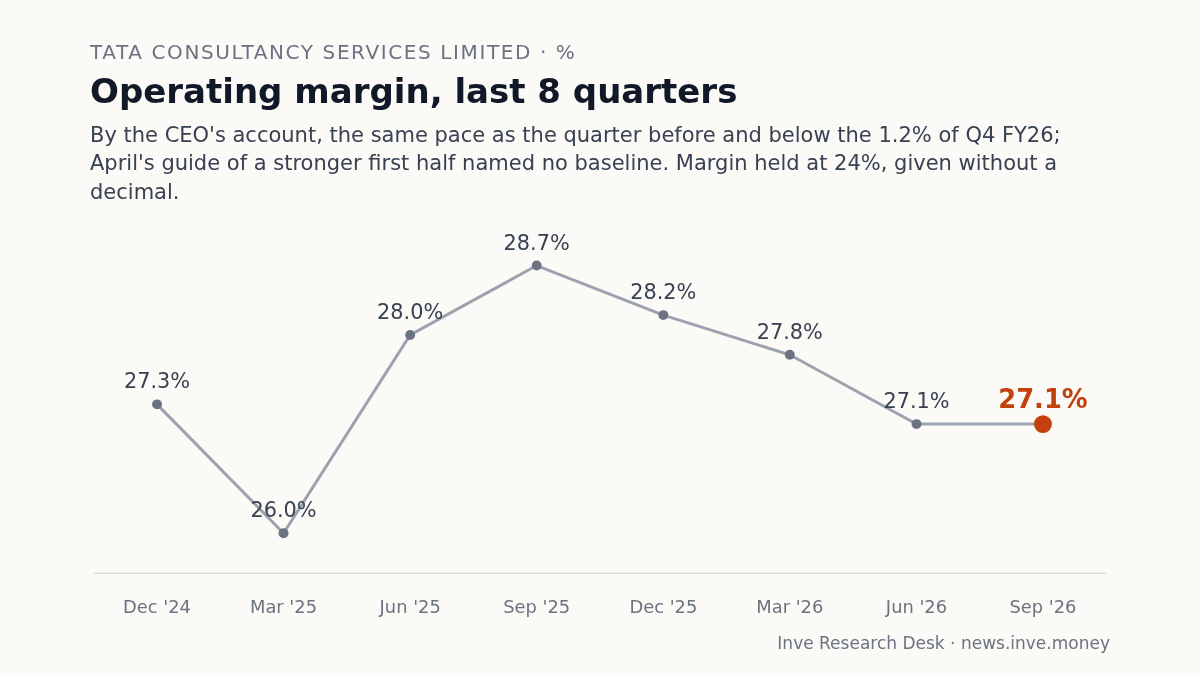
The margin is holding, and the year-end goal has gone quiet
In April the finance chief said the annual pay rise would cost 150 to 200 basis points of margin, as in past cycles. Last quarter the company gave its operating margin as 24%, without a decimal, against 25.3% before the pay rise. By our arithmetic that is a fall of about 1.3 points if 24% is exact, at or below the low end of the hit flagged.
What held it there matters more than the figure. The finance chief named currency gains and operating leverage, and told an analyst of a lower outlay this time, given its performance against internal targets. Pushing the other way were a larger bench of staff hired ahead of projects, more subcontractors, and spending on partnerships and acquisitions. And the company expects a drag in the second half from a proposed acquisition, whose timing depends on approvals.
Four asked about 25%; the CFO gave no figure or date
Four analysts on the call asked about a year-end operating margin of 25%. At least two described it as the company's own commitment or guidance. We did not find the figure in our summaries of the January and April calls, which record the finance chief speaking of climbing toward 26% (January) and moving toward 26% on a longer-term basis (April).
On this call the finance chief neither repeated nor disowned it, and gave it no date or figure on the call. One reply to an analyst is garbled in the transcript (it reads 'we want to end up' and then turns to investment), so we do not build on it. He said the long-term aspiration stands and that near-term priority is investment. His one summary was this: "While it is an uphill task, we'll continue to endeavor to inch up on our margins." A long-term aspiration costs nothing to repeat. A year-end number can be checked at the year-end results, two reports away, with the acquisition drag still to come.
AI is growing; by our arithmetic the rest is shrinking
The line management showcased most is AI. Its annualised revenue went from above $2.3 billion in April to above $3.1 billion now, over a tenth of revenue. An analyst put the quarter's AI growth at 19% and no one on the call disputed it; its basis was not stated on the call. By our arithmetic AI added more quarterly revenue than the whole company did, which implies, on these inputs, that the rest of the business shrank by about 1.2%. That rests on an analyst's number and on revenue we approximate, and the call carried no definition of AI revenue. The COO, answering another analyst, said the company is also gaining share in traditional services, helped by vendor consolidation, so the split is not one management draws. In April, asked about margins on AI and data services, management declined to give one; this time the finance chief said AI revenue is "coming in at a much higher margin than our company average." No number came with it.
What would have to be true, and what we do not know
The finance chief's route to a higher margin runs through growth putting the larger bench to work and lower subcontractor cost. Among the levers the finance chief named were utilisation, productivity, subcontractor cost and the rate average. Against that stand the second-half drag and the usual year-end furlough season.
An analyst put the fall in India revenue at about 10%, which the chief executive attributed to a project deferral; he gave no date on the call for its return and said the revenue should come. We do not hold the July call, so we cannot say whether the 25% was set there. On this call the company repeated the long-term aspiration and stayed vague on the number analysts say comes due soon.
Tata Consultancy Services stock page →
The record: notes, full financial tables
Notes
Impact 4/5 Margin Negative
TCS finance chief stops short of the 25% year-end margin analysts asked about
Four analysts asked about a 25% year-end operating margin; the finance chief offered neither a figure nor a date, saying it would keep trying to inch up. The company gave its margin as 24%, without a decimal, against 25.3% in Q4 FY26, by our arithmetic a fall of about 1.3 points if 24% is exact, at or below the low end of the 150 to 200 basis point pay-rise hit flagged in April. Our January and April 2026 call summaries record only a climb toward 26%; the finance chief expects about 50 basis points of drag from a proposed acquisition in the second half, depending on when it closes.
“While it is an uphill task, we'll continue to endeavor to inch up on our margins.”— Samir Seksaria, CFO
Impact 4/5 Demand Mixed
TCS AI run-rate passes $3.1 billion; on an analyst's 19% figure the rest shrank about 1.2%
The company said annualised AI revenue passed $3.1 billion, over 10% of revenue, up from $2.3 billion on 9 April 2026 and $1.8 billion on 12 January. An analyst put the quarter's AI growth at 19% and total constant-currency growth was 0.5%; by our arithmetic, on quarterly revenue near $7.6 billion, the non-AI business shrank about 1.2%. In April, asked about AI and data services margins, management declined to give one; now the finance chief calls it well above average, with no number. The basis of the 19% was not stated on the call, and the COO, answering another analyst, said the company is also gaining share in traditional services.
“coming in at a much higher margin than our company average.”— Samir Seksaria, CFO
Impact 3/5 Margin Mixed
TCS held its margin at 24% as bench and subcontractor costs rose, cushioned by currency
The finance chief said costs rose on a larger bench, more subcontractors and spending on partnerships and acquisitions, offset partly by currency gains and operating leverage; he told an analyst the company had a lower outlay this time, given its performance against internal targets. The margin was 24% last quarter against 25.3% in Q4 FY26, after a pay rise the company flagged on 9 April 2026 at 150 to 200 basis points. The question is whether subcontractor and bench costs fall as staff are deployed.
“we have invested in a higher bench and increased hiring of subcontractors to meet near-term skills and delivery requirements.”— Samir Seksaria, CFO
Financials
Income statement, last 8 quarters
| Quarter end | Sales | YoY | Operating profit | Op. margin | Other income | PBT | Net profit |
|---|---|---|---|---|---|---|---|
| Sept 2026 | 60,441 | +10.8% | 16,395 | 27.1% | 3,049 | 18,276 | 14,104 |
| Jun 2026 | 59,553 | +12.8% | 16,133 | 27.1% | 2,738 | 17,709 | 13,642 |
| Mar 2026 | 58,052 | +7.2% | 16,130 | 27.8% | 3,516 | 18,464 | 14,526 |
| Dec 2025 | 55,567 | +3.1% | 15,694 | 28.2% | −1,168 | 12,912 | 10,190 |
| Sept 2025 | 54,531 | +1.0% | 15,668 | 28.7% | 918 | 15,244 | 11,828 |
| Jun 2025 | 52,788 | −0.1% | 14,757 | 28.0% | 2,703 | 16,186 | 12,552 |
| Mar 2025 | 54,136 | +5.1% | 14,069 | 26.0% | 1,922 | 14,672 | 11,116 |
| Dec 2024 | 53,883 | +6.0% | 14,727 | 27.3% | 2,118 | 15,509 | 11,832 |
Balance sheet
| As of | Equity | Debt | Investments | Fixed assets | CWIP | Total assets |
|---|---|---|---|---|---|---|
| Sept 2026 | 96,604 | 9,870 | 44,714 | 19,041 | 2,049 | 1,58,286 |
| Mar 2026 | 84,676 | 9,354 | 41,090 | 17,710 | 2,402 | 1,49,010 |
| Sept 2025 | 1,06,415 | 10,932 | 39,062 | 24,149 | 2,221 | 1,75,219 |
| Mar 2025 | 75,617 | 7,577 | 32,802 | 16,825 | 1,318 | 1,32,586 |