Indian Bank · INDIANB
Indian Bank books an NSE windfall and nearly doubles provisions ahead of new loan rules
A one-time gain of about ₹1,386 crore on NSE shares helped lift operating profit 46.6%; provisions the chief executive tied to coming loan-loss rules held net profit growth to 14.7%.
Published · Updated · Inve Research Desk

₹2,222 crore
provisions excluding tax, September quarter, standalone
Nearly double the June quarter's ₹1,196 crore, set aside in the quarter in which a one-time gain on NSE shares lifted income.
How they did last quarter
A one-off NSE gain lifted operating profit, provisions nearly doubled, and the core business grew a little faster than in June.
- Operating profit, standalone₹7,090 crore, up 46.58% on a year earlier; about 18% without the NSE gainvs 16.51% growth in the June quarterWithout the one-off, operating profit grew a little faster than in June.
- Provisions excluding tax, standalone₹2,222 crorevs ₹1,196 crore in the June quarter and ₹739 crore a year earlierThe rise came in provisions on loans still being repaid; those on bad loans held flat.
- Gross bad loans1.61% of loansvs 1.86% in June; FY27 guidance "1.50% ~ 1.60%"A hair above the top of the range the bank wants by March 2027, with half the year left.
An NSE windfall, matched by a bigger provision bill
Indian Bank holds shares in the National Stock Exchange, which listed during the quarter. Managing director and chief executive Binod Kumar said the bank booked ₹252 crore of profit on them and a further ₹1,134 crore from revaluing the holding to market, about ₹1,386 crore in all, which he called one-time. The results presentation shows the revaluation line jumping to ₹1,123 crore, from ₹109 crore in June.
The gain lifted operating profit, the bank's income before provisions and tax, 46.58% from a year earlier to ₹7,090 crore; without it, Kumar said, growth was 18%. Net profit rose a slower 14.71%, to ₹3,462 crore, mainly because provisions, the money a bank sets aside against loan losses, jumped to ₹2,222 crore from ₹739 crore a year earlier. Measured over the year, the rise in provisions, ₹1,483 crore, was slightly larger than the gain itself.
Kumar says the extra is for rules that start in April 2027
Kumar tied the heavier provisions to the Reserve Bank's switch to expected-credit-loss (ECL) provisioning, which banks adopt from April 2027. Banks already keep a small provision against loans that are still being repaid; under ECL it has to reflect the losses they expect on those loans. In July Kumar put that provision at about 0.4-0.5% today and perhaps 1.5% under ECL, and the one-time cost of the switch for Indian Bank at ₹3,000-3,500 crore.
The presentation shows where the money went. Provisions against standard loans, those still being repaid, rose to ₹1,882 crore from ₹733 crore in June, while provisions against bad loans held at about ₹370 crore. It does not label any line ECL. An analyst suggested the bank had taken advantage of the NSE gain and asked whether the extra was for ECL. Kumar said provisions had been made for it and that it made sense to make them "when time is good". He now puts the total cost at ₹3,500 crore.
That is the plan he has described all year. In January he said the bank would not spread the cost over five years and would provide wherever it could, so that the quarter of the switch took little of the hit. In April he spoke of absorbing it in roughly six to nine months.
Beneath the one-off, the lending business did well
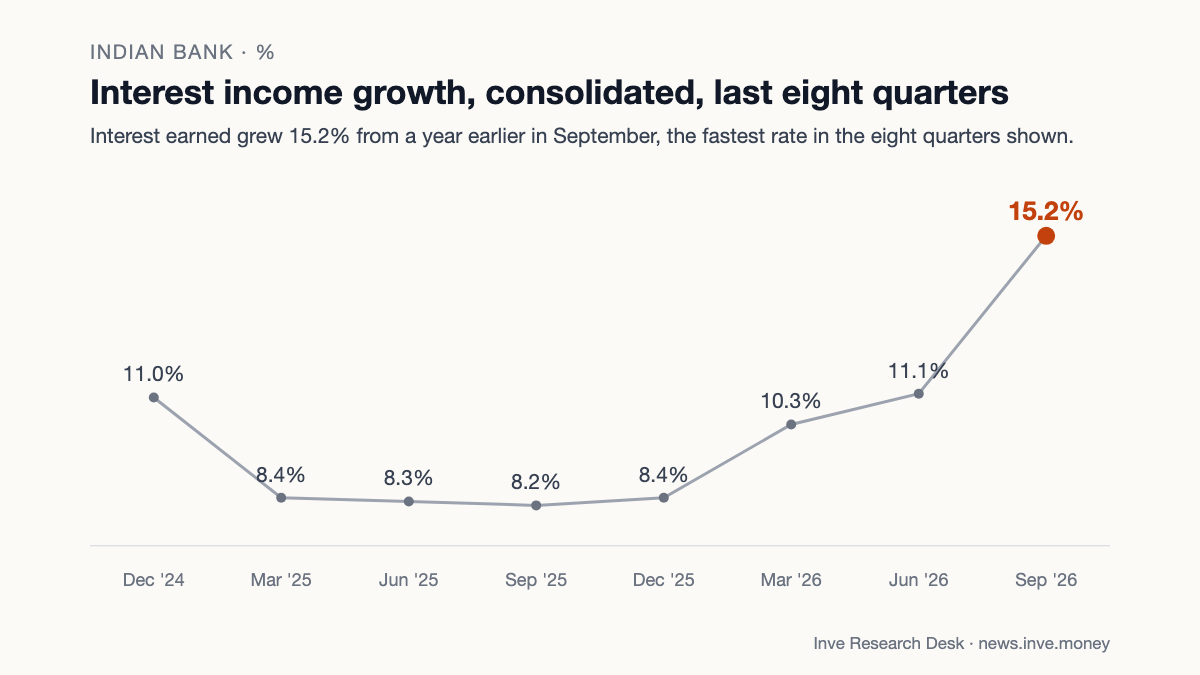
Net interest income, what the bank earns on loans and investments less what it pays for its funds, rose 17.83% from a year earlier to ₹7,719 crore, and the net interest margin edged up to 3.31% from 3.29% in June. The first half's 3.30% is already above the 3.10-3.25% the bank guides to for the year. Kumar expects another 5 to 7 basis points this quarter; he gave both 5-6 and 6-7 on the call. The Reserve Bank's 25-basis-point repo rate rise, he said, began lifting rates on the half of the loan book tied to external benchmarks the next day.
Bad loans kept falling, to 1.61% of the book from 1.86% in June. Asked whether fast lending to small businesses, farmers and retail borrowers was showing strain, Kumar said: "Not reflecting so far. I mean, very candidly, I'm saying not reflecting so far." Two smaller sources of income may fade: he agreed that interest on an income-tax refund, ₹271 crore by an analyst's figure, may not recur, and he expects treasury income to be muted.
A bond revaluation sits outside the ₹3,500 crore
Kumar's ₹3,500 crore covers loans only. Asked whether it included the held-to-maturity book, bonds a bank intends to keep until they mature and so does not mark to market, he said any hit there would come on top. As he read the final rules, banks would have to revalue that book to market once, at the switch. Citing where yields already stand, he said: "If that happens, then every bank will have a huge impact on that." He had warned in April that bringing the book into the rules would raise the cost.
Indian Bank's domestic held-to-maturity book was ₹170,987 crore at the end of September, about two-thirds of its domestic investments. Rising yields have already hit the bonds it does mark: the reserve on its available-for-sale book went from a gain of ₹503 crore in June to a loss of ₹123 crore, Kumar said. He gave no estimate of the held-to-maturity mark on the call; banks, he said, would first take the matter up with the Reserve Bank.
The record: notes
Notes
Impact 4/5 Guidance Positive
Indian Bank raises its loan and deposit growth guides for the year
Kumar raised the bank's guide for loan growth this fiscal year to 13-14%, from the 11-13% given in April, and for deposit growth to 11-12%, from 9-11%. At the end of September loans were 16.39% and deposits 12.50% above a year earlier. He said the loan growth had come mainly from loans taken against foreign-currency (FCNR) deposits, which may not recur next quarter.
“I'm revising that to 11% to 12%.”— Binod Kumar, MD and CEO
Impact 3/5 Balance sheet Mixed
Short-term borrowing rose and pulled liquidity cover down to 116%
Borrowings were ₹77,195 crore at the end of September, against ₹48,147 crore in June, on the bank's standalone balance sheet. Kumar said repo-type borrowing had risen, that he did not expect it to decline, and that it had pulled the liquidity coverage ratio down to 116%, from 123% in the June quarter. The bank raised FCNR deposits worth roughly ₹21,000 crore, by his figure, partly to let about ₹10,000 crore of bulk deposits run off.
“So there is no surplus liquidity on account of FCNR with us.”— Binod Kumar, MD and CEO