
Anand Rathi Share and Stock Brokers · ARSSBL
Anand Rathi's profit rose 50% on a smaller interest bill while its operating margin slid to 36.6%
Anand Rathi's quarterly profit jumped by half, but most of the gain came from paying less interest on client cash that has since left, and management lowered its growth guidance while borrowing more.
Published · Inve Research Desk
Anand Rathi Share and Stock Brokers stock page → More news from 15 Oct 2026

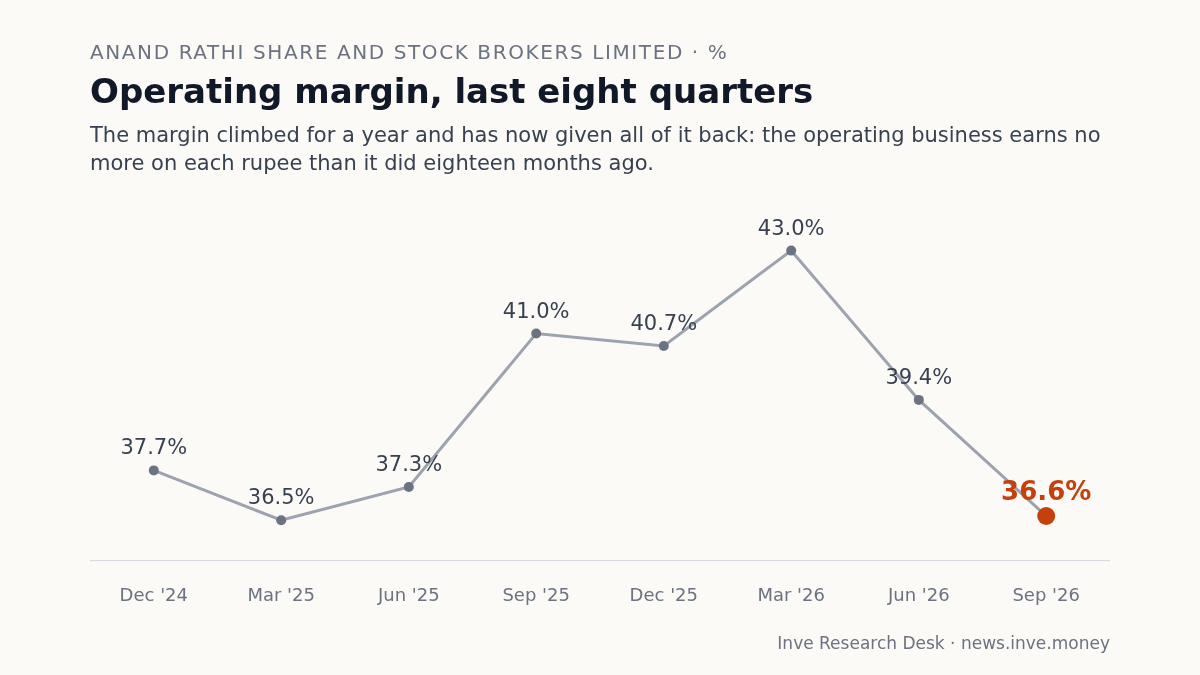
36.6%
operating margin last quarter
Down from 41.0% a year earlier and 43.0% two quarters before: costs grew faster than revenue, so most of the jump in profit came from somewhere else.
How they did last quarter
Revenue and profit came in ahead of the company's new guidance, but the business kept less of each sale and the profit gain rested mostly on a lower interest bill.
- RevenueRs 273 crore, +20.3% on a year agovs Guidance on this call of "about 15% to 20% on top line"Just above the new band, and inside the 20-25% band management gave in July.
- Net profitRs 42 crore, +50% on a year agovs Guidance on this call of "about 25% to 30% on the bottom line"Well ahead, but by our arithmetic about two-thirds of the rise in pre-tax profit came from lower interest.
- Operating margin36.6%vs 41.0% a year ago and 39.4% the quarter beforeCosts rose about 29% by our arithmetic, faster than revenue, so each sale earned less.
- Margin-trading bookRs 1,499 crore at the end of Septembervs Year-end "guidance of INR 17,500 million to INR 18,000 million"About 83% of the top of the range by our arithmetic, with half the year left, funded by more borrowing.
A bigger quarter that kept less of each sale
Anand Rathi Share and Stock Brokers opened its results by stressing its revenue and profit. Net profit did rise by half on a year ago. But the number a holder should look at first is a different one: the operating margin, what the business keeps from each rupee of revenue before paying interest, fell to 36.6% from 41.0% a year earlier.
Revenue grew 20.3% in the September 2026 quarter. Costs grew faster, by about 29% by our arithmetic. Management said much of the rise in staff costs was a one-time step, people who had worked through outside contractors moving onto the payroll, while it keeps hiring relationship managers. So the operating business, the part that earns from trading and lending, grew its profit only a little.
The profit came from a smaller interest bill
If the margin fell, the profit had to come from somewhere, and it came from the interest line. The company paid noticeably less interest than a year earlier, even though it owed more. By our arithmetic, about two-thirds of the rise in pre-tax profit came from that saving, and only about a third from the operating business.
Management explained why. Wealthy clients who had kept cash with the firm as margin, and had been paid interest on it, moved that money into government bonds pledged in its place. The departure shows in the filed balance sheet: total assets have shrunk by more than a third since March. A saving that comes from money leaving does not recur at the same pace. Once the cash has gone, there is no more interest on it to stop paying.
Meeting its revenue guidance, then lowering it
In July management guided to revenue growth of 20-25%. Three months later, with first-half revenue up 21%, near the bottom of that band, it closed the call with lower bands: 15-20% for revenue, and five points less for profit than it had said in July. The revenue band is the one it gave in April. On profit the company said first-half growth was 29% after a Rs 21 crore exceptional charge in April-June, just under July's band. It gave no reason for the change on the call, and no analyst asked.
A company that lowers its revenue guidance while meeting it is doing one of two things. It is building a cushion, or it is quietly telling holders that the months ahead look harder than the months behind. We cannot tell which from what was said. Either way, the bar is lower than it was in July, and the company chose to lower it.
Borrowing more to grow the lending book
The growth management wants most is in margin-trading loans, money lent to clients to buy shares. In April the company said that book had shrunk in the three months to March, mainly because an RBI rule change cut the bank funding it could draw on and it had to hold back lending, and that it had missed its target for March. It now stands at Rs 1,499 crore, against year-end guidance of Rs 1,750-1,800 crore. Borrowings rose by two-thirds in six months, to Rs 1,412 crore, and the debt-to-equity ratio reached 1.02, against a ceiling of 1.5 the company set in April.
Turn it around and ask how an owner gets hurt. A market fall would shrink the lending book and the broking income at the same time, while the borrowings and the larger payroll stay where they are. A funding squeeze can shrink the book too: that is what happened earlier this year, when an RBI rule cut the bank lines the company could use. The plan works if clients keep trading and borrowing, and if the company's own funding stays cheap as its debt climbs.
Debt, equity and total assets
Since March 2026 debt has risen by two-thirds while equity barely moved, and total assets shrank as client money left.
₹ crore
| Debt | Equity | Total assets | |
|---|---|---|---|
| Mar 2025 | 914 | 504 | 3,365 |
| Sept 2025 | 1,214 | 1,302 | 5,150 |
| Mar 2026 | 840 | 1,348 | 7,099 |
| Sept 2026 | 1,412 | 1,384 | 4,491 |
What the next quarters will show
The part of the business meant to make earnings steadier has not yet done so. Distribution assets, money clients have placed in funds and products through the firm, grew 29% on a year ago, while the income from them barely moved. Management called it a matter of timing, as commissions shift from upfront payments to smaller fees paid over the years. In January it had said the assets it was gathering would show up in revenue within two quarters, and in those two quarters distribution income did rise, by about a third on a year earlier in each; the lag is this quarter's, against a year-earlier quarter in which the income had grown 74%.
We don't know yet whether the interest saving lasts, why the guidance came down, or when the fee income catches up with the assets. The next results will answer some of it.
Managements tend to lead with the number that flatters. This one led its financial review with revenue and profit and left the lower revenue and profit bands for its closing remarks.
Anand Rathi Share and Stock Brokers stock page →
The record: notes, full financial tables
Notes
Impact 4/5 Guidance Negative
Anand Rathi cuts growth guidance to 15-20% revenue and 25-30% profit, from July's bands
Management closed the 14 October 2026 call by guiding revenue growth of 15-20% and profit growth of 25-30%, after saying in Q&A that non-broking would grow about 30-35%, or 40% in some cases. Revenue rose 20.3% and net profit 50% in the September 2026 quarter, first-half revenue was up 21% by our arithmetic, and first-half profit after a Rs 21 crore exceptional charge rose 29%, the company said. On 15 July 2026 it had guided 20-25% for revenue and 30-35% for profit, and on 15 April 2026 15-20% for revenue and 40-45% for non-broking. It gave no reason for the lower bands on the call.
“is committed the growth of about 15% to 20% on top line and about 25% to 30% on the bottom line”— Pradeep Gupta, Chairman and Managing Director
Impact 4/5 Margin Mixed
Anand Rathi profit up 50% on lower interest; operating margin falls to 36.6% from 41.0%
Net profit rose 50% to Rs 42 crore in the September 2026 quarter, yet operating margin fell to 36.6% from 41.0% a year earlier as costs rose about 29%, by our arithmetic, against revenue up 20.3%. Interest fell to Rs 38 crore from Rs 50 crore, which management put down to clients moving cash margins into pledged government bonds; by our arithmetic that supplied Rs 12 crore of the Rs 18 crore rise in pre-tax profit. Management called most of the jump in salaries a one-off from moving outsourced staff onto the payroll. The margin was 39.4% the quarter before.
“is largely onetime kind of impact which is happening over here”— Pradeep Gupta, Chairman and Managing Director
Impact 3/5 Balance sheet Mixed
Anand Rathi borrowings up 68% in six months to Rs 1,412 crore; debt-to-equity at 1.02
The debt-to-equity ratio reached 1.02 at 30 September 2026, as the company funded its margin-trading loans with borrowing while client cash moved into pledged government bonds. Borrowings were Rs 1,412 crore, up from Rs 840 crore at 31 March 2026, and total assets fell to Rs 4,491 crore from Rs 7,099 crore as client money left. The ratio was 0.62 in March and 0.81 in June 2026, and on 15 April 2026 management set a ceiling of 1.5. Funding the top of its year-end loan-book guidance entirely with debt would take the ratio to about 1.24, by our arithmetic.
“we continue to maintain disciplined leverage and adequate liquidity as we scale our MTF and other growth initiatives”— Roop Bhootra, Whole-time Director
Impact 3/5 Demand Negative
Anand Rathi distribution income up 3.5% while distribution assets grew 29%
Distribution income was Rs 32.7 crore in the September 2026 quarter, up 3.5% on Rs 31.6 crore a year earlier by our arithmetic, while distribution assets rose 29% to Rs 9,999 crore. Management blamed a shift from upfront commissions to trail fees, and a rule change that lengthened to 12 months the wait for commission on transferred fund assets. On 15 January 2026 it had said the assets it gathered would show in revenue within three to six months; distribution income rose 34% and 31% year on year in the two quarters that followed, before this quarter's slowdown against a year-earlier quarter that had grown 74%.
“This is not going to be a continuous phenomena over a period of time.”— Pradeep Gupta, Chairman and Managing Director
Impact 3/5 Guidance Positive
Anand Rathi margin-trading book reaches Rs 1,499 crore, keeps Rs 1,750-1,800 crore guide
The margin-trading book, money lent to clients to buy shares, stood at Rs 1,499 crore at 30 September 2026, and management kept its year-end guidance of Rs 1,750-1,800 crore. The book grew Rs 397 crore from Rs 1,102 crore at 31 March 2026; the 57% of target management cited measures that increase against the top of the range, not the book, by our arithmetic. On 15 April 2026 the company said the book had fallen 10.5% in the March 2026 quarter, missing its target of about Rs 1,500 crore.
“we have already achieved almost 57% of our target in the first half of the financial year”— Roop Bhootra, Whole-time Director
Financials
Income statement, last 8 quarters
| Quarter end | Sales | YoY | Operating profit | Op. margin | Other income | PBT | Net profit |
|---|---|---|---|---|---|---|---|
| Sept 2026 | 273 | +20.3% | 100 | 36.6% | 0.0 | 56.0 | 42.0 |
| Jun 2026 | 246 | +22.4% | 97 | 39.4% | −21.0 | 31.0 | 23.0 |
| Mar 2026 | 256 | +28.0% | 110 | 43.0% | 0.0 | 54.0 | 42.0 |
| Dec 2025 | 248 | +21.6% | 101 | 40.7% | 1.0 | 50.0 | 37.0 |
| Sept 2025 | 227 | −1.7% | 93 | 41.0% | 1.0 | 38.0 | 28.0 |
| Jun 2025 | 201 | −4.7% | 75 | 37.3% | 1.0 | 30.0 | 23.0 |
| Mar 2025 | 200 | – | 73 | 36.5% | 0.0 | 26.0 | 18.0 |
| Dec 2024 | 204 | – | 77 | 37.7% | 0.0 | 29.0 | 22.0 |
Balance sheet
| As of | Equity | Debt | Investments | Fixed assets | CWIP | Total assets |
|---|---|---|---|---|---|---|
| Sept 2026 | 1,384 | 1,412 | 21.0 | 85.0 | 0.0 | 4,491 |
| Mar 2026 | 1,348 | 840 | 33.0 | 78.0 | 0.0 | 7,099 |
| Sept 2025 | 1,302 | 1,214 | 49.0 | 82.0 | 0.0 | 5,150 |
| Mar 2025 | 504 | 914 | 6.0 | 84.0 | 0.0 | 3,365 |