Adani Green Energy · ADANIGREEN
Adani Green's capacity target for the year now waits on one delayed Khavda power line
The renewable producer kept its capacity target for the year only on condition that a delayed transmission line arrives by March, leaving two-thirds of the low end still to build in the second half, much of it waiting on that line.
Published · Inve Research Desk
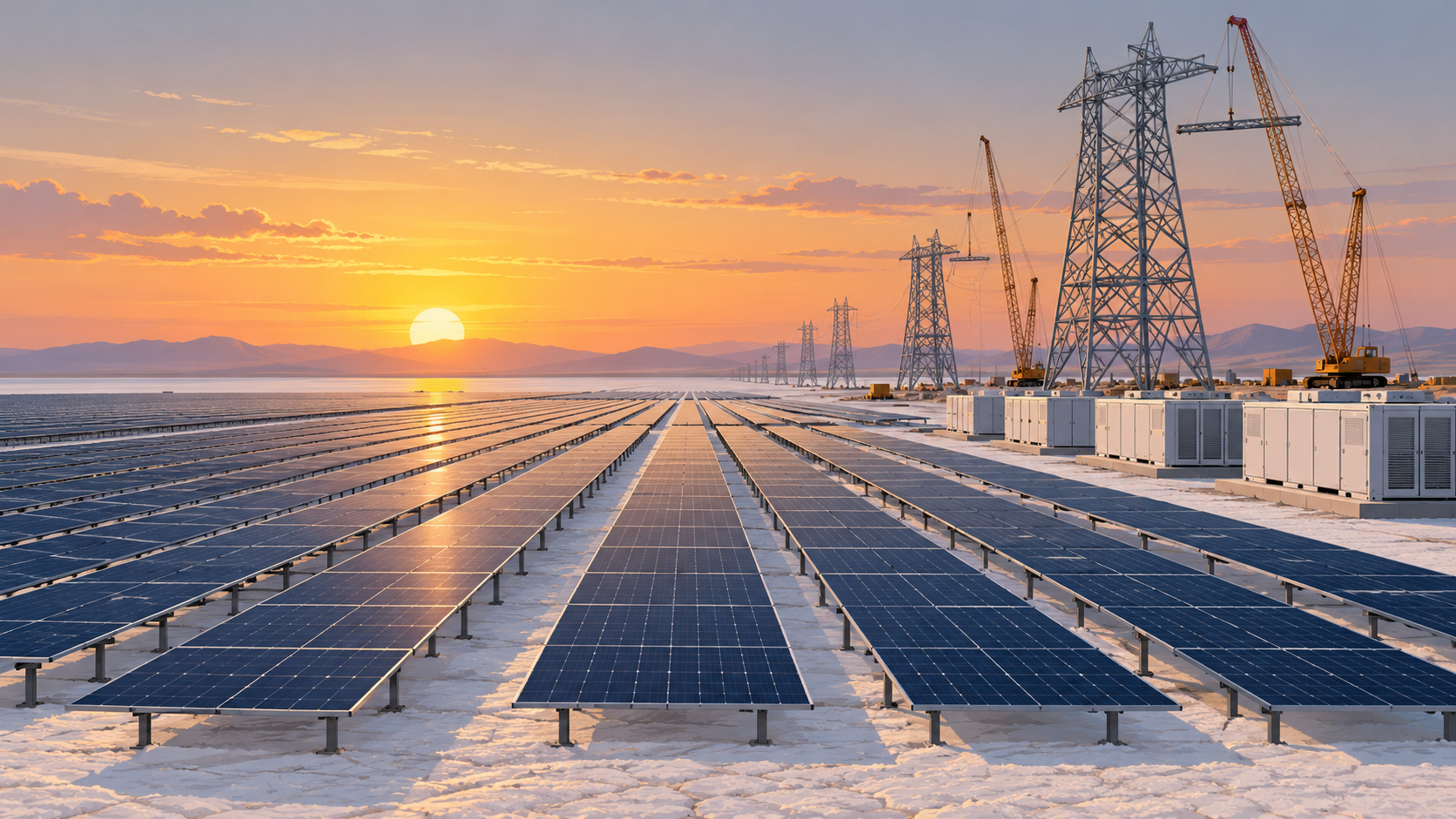
Adani Green Energy builds solar and wind farms and sells their power, much of it from a very large site at Khavda, where electricity can only be sold once the grid has lines to carry it away. In April the company guided to adding 4.5-5 GW of new capacity this financial year, and expected a new line out of Khavda to open by December. Its chief executive, Ashish Khanna, now gives a later date: "Now we are expecting this transmission line of Phase 3, the evacuations to come by the next quarter." He said the capacity target holds if the line arrives by the end of March.
Operating capacity grew by 1.5 GW in the six months to the end of September, calculated from Inve's March figure and the capacity the company reported for September. Reaching only the bottom of the range would mean commissioning a further 3.0 GW in the second half, twice the first half's additions, by our arithmetic.
Meeting even the low end of the target needs twice the first half's additions in the second half
GW
- Added in the first half 1.5 GW
- Still needed in the second half 3.0 GW
- Added in the whole previous year 5.1 GW
Management argues it is ready for that. Mr Khanna said the company is finishing everything at the sites except the solar modules, so that modules can go on quickly once a line is certain, and in the previous financial year it added more capacity than this year's whole target. The second line out of Khavda, which the company had expected by March as well, now also looks delayed, he said.
The shortage of lines is already costing money. When a line is full, power that cannot be scheduled for delivery is not paid for, and plants are told to produce less, which the industry calls curtailment. The company said first-half EBITDA, its earnings before interest, tax, depreciation and amortisation, was ₹8,276 crore and would have been close to ₹9,000 crore without curtailment. That gap, roughly ₹700 crore on the company's rounded estimate, appears already to exceed the about ₹500 crore lost to curtailment in the whole of the previous year. In July the company expected the problem to be resolved by the end of the calendar year as the new lines arrived.
Batteries are the hedge the company offers. They store solar power at midday and release it when the lines have room. Installed storage reached 6.6 GWh by the end of September, the company expects to exceed 10 GWh this year, and Mr Khanna said curtailment in the second half should be lighter because of them. They absorb only part of the problem: a company executive's rule of thumb is to divide storage by roughly five to get the solar capacity it can support, which would let this year's storage target support about 2 GW of solar, well short of the capacity planned this year. Only 3.5 GWh of the installed storage has a buyer so far, Mr Khanna said.
Despite curtailment, the plants already running grew strongly. The company said revenue from power supply rose 45% from a year earlier in the September 2026 quarter and EBITDA from power supply rose 51%. Part of that came from wind output with no long-term contract, sold instead at market prices. Another 5.3 GW already has contracts signed but sells at market prices until grid connections are completed, which the company said in April would happen by December, with some by March.
Leverage is high and will stay so for years. In January the company put its overall ratio of debt to run-rate EBITDA at about 5.6 and said it would stay around there for the next two to three years. Mr Khanna now says leverage stays at about this level until nearer FY28-29 and eases only after that, arguing that a delay of a few months does not change the leverage profile of plants that run for decades. By the company's own condition, if the Khavda line arrives after March, part of this year's planned capacity moves into the next.
Adani Green Energy stock page →
The record: full financial tables
Financials
Income statement, last 8 quarters
| Quarter end | Sales | YoY | Operating profit | Op. margin | Other income | PBT | Net profit |
|---|---|---|---|---|---|---|---|
| Sept 2026 | 7,890 | +99.9% | 206 | 2.6% | 291 | 22 | 33 |
| Jun 2026 | 6,206 | +29.6% | 72 | 1.2% | 266 | −86 | −51 |
| Mar 2026 | 6,249 | −3.3% | 169 | 2.7% | 190 | −26 | 13 |
| Dec 2025 | 3,355 | −43.3% | 145 | 4.3% | 281 | 82 | 82 |
| Sept 2025 | 3,947 | +1.5% | 421 | 10.7% | 251 | 331 | 475 |
| Jun 2025 | 4,789 | +43.3% | 205 | 4.3% | 196 | 36 | 34 |
| Mar 2025 | 6,461 | −11.5% | 304 | 4.7% | 253 | 171 | 83 |
| Dec 2024 | 5,922 | +183.5% | 775 | 13.1% | 239 | 573 | 557 |
Balance sheet
| As of | Equity | Debt | Investments | Fixed assets | CWIP | Total assets |
|---|---|---|---|---|---|---|
| Sept 2026 | 14,912 | 25,932 | 31,623 | 3,365 | 1,419 | 54,080 |
| Mar 2026 | 14,890 | 22,558 | 28,995 | 3,384 | 953 | 51,955 |
| Sept 2025 | 19,524 | 88,153 | 3,047 | 88,401 | 16,691 | 1,25,877 |
| Mar 2025 | 8,212 | 20,244 | 23,747 | 1,501 | 669 | 41,867 |