General Electric Company · GE
GE Aerospace's margin gain came mostly from lower corporate costs
GE's third-quarter operating margin rose 220 basis points, but most of the gain came from corporate costs falling against a heavy year-earlier quarter, and its finance chief expects the margin to stay flat next year.
Published · Inve Research Desk
General Electric Company stock page → More news from Oct 23, 2026
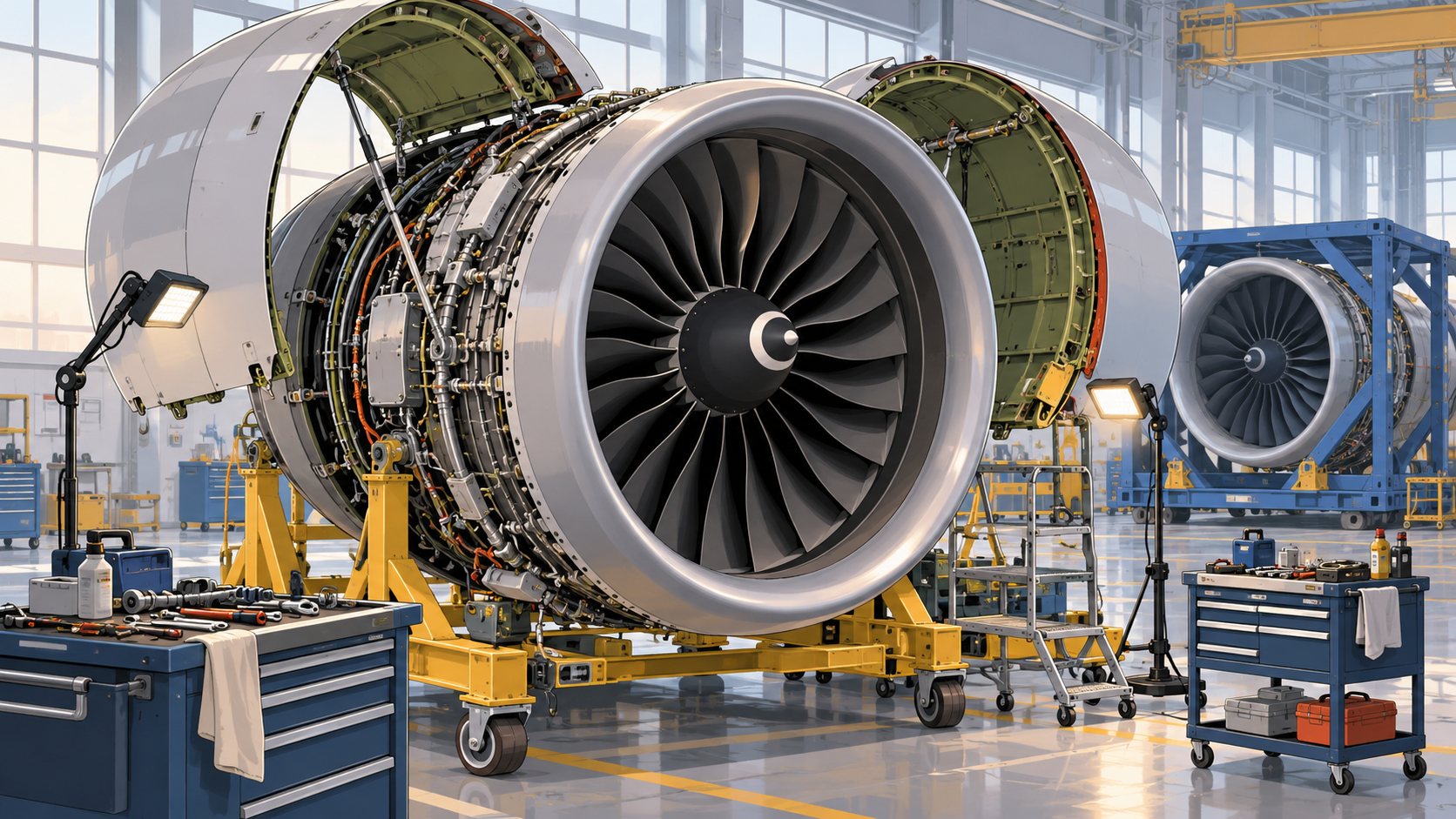
GE Aerospace, which builds and services jet engines for airlines and the military, reported an operating margin of 22.5% for the September 2026 quarter, up from 20.3% a year earlier. The measure is adjusted operating profit divided by adjusted revenue, and it had fallen year on year in both earlier quarters of the year. Rahul Ghai, the chief financial officer, put the turn down to services volume, productivity and price.
GE's operating margin turned up last quarter after falling year on year in the first half
bp
- Q1 2026 -200 bp
- Q2 2026 -130 bp
- Q3 2026 +220 bp
Most of that gain comes from outside the engine businesses. GE reports one line for corporate costs and eliminations: the parent's own overhead plus the adjustment that removes sales between its units. That line fell to $373 million from $525 million a year earlier. Calculated from the reported figures, the smaller cost on a larger revenue base accounts for about 184 basis points of the margin gain. The two operating segments, Commercial Engines & Services and Defense & Propulsion Technologies, supplied the rest by earning slightly more profit per dollar of company revenue.
Lower corporate cost explains most of the margin gain; the engine segments added little
bp
- Lower corporate cost and eliminations 183.6 bp
- Higher segment profit share 32.66 bp
- Total margin change 215.5 bp
Ghai said "corporate cost was lower by about $160 million from timing of accruals and cost management initiatives". Those are different kinds of saving. Accrual timing concerns when a cost is booked, so it can move back the other way in a later quarter; cost programmes can last. He gave them as a single figure.
The comparison also flatters the quarter. Working back from the nine-month figures, the corporate line in the year-earlier quarter was nearly three times its quarterly average for the first half of that year. This year ran the other way: the first-half average was higher than last year's, and last quarter's cost, though lower than a year ago, sat above it. Eliminations are also rising over the first nine months.
Corporate cost fell against a heavy 2025 quarter but stayed above this year's first-half pace
$m
2025
- $181M H1 quarterly average
- $525M Q3
2026
- $296.5M H1 quarterly average
- $373M Q3
The engine businesses tell a steadier story. The commercial engines margin was 230 basis points below the year before in the first quarter and only 10 below last quarter, but last quarter's figure leaves out the GE9X engines delivered in the quarter, whose impact is booked only after the FAA certifies the upgraded mid-seal, and Ghai expects GE9X losses to add about $300 million of headwind next year. The defence unit's margin edged up. Over nine months, operating profit grew 22% on adjusted revenue up 23%: profit is growing at about the pace of sales.
GE's guidance points the same way. It raised its 2026 operating profit range to $10.9 billion to $11.0 billion and now expects corporate costs and eliminations near the lower end of its range. About $100 million of the increase is a smaller loss on the GE9X engine it supplies to Boeing, because engines already delivered are booked only after the FAA certifies an upgraded seal, which GE is working to secure before the year ends. That loss is moved into a later period. For next year, Ghai expects the margin to hold at this year's level even as those engine losses grow, with expansion only from 2028 as they ease.
Taken together, last quarter's margin reflects a lighter corporate bill against a heavy one a year earlier more than a new level of profitability in the engine businesses. GE will give fuller guidance for next year in January; so far it has guided that commercial services should grow at a low-double-digit rate that year. Ghai expects next year's profit growth to come mainly from services, with services margins at least holding, plus defence, partly offset by new engines.
General Electric Company stock page →
The record: full financial tables
Financials
Income statement, last 8 quarters
| Quarter end | Sales | YoY | Other income | PBT | Net profit |
|---|---|---|---|---|---|
| Sep 2026 | 14,118 | +15.9% | 432 | 2,805 | 2,288 |
| Jun 2026 | 13,349 | +21.1% | 313 | 2,801 | 2,370 |
| Mar 2026 | 12,392 | +24.7% | −16 | 2,198 | 1,904 |
| Dec 2025 | 12,716 | +17.6% | 602 | 2,851 | 2,541 |
| Sep 2025 | 12,181 | +23.8% | 285 | 2,515 | 2,157 |
| Jun 2025 | 11,023 | +21.2% | 298 | 2,389 | 2,028 |
| Mar 2025 | 9,935 | +10.9% | 302 | 2,245 | 1,978 |
| Dec 2024 | 10,812 | +14.3% | 299 | 2,293 | 1,899 |
Balance sheet
| As of | Equity | Debt | Cash | Total assets |
|---|---|---|---|---|
| Sep 2026 | 17,522 | 19,326 | 8,764 | 127,195 |
| Jun 2026 | 17,640 | 19,157 | 9,345 | 127,672 |
| Mar 2026 | 18,057 | 20,277 | 10,981 | 128,445 |
| Dec 2025 | 18,677 | 20,494 | 12,392 | 130,169 |
Cash flow
| Year end | Operating | Investing | Financing | Free cash flow |
|---|---|---|---|---|
| Dec 2025 | 8,537 | −1,153 | −8,682 | 7,264 |
| Dec 2024 | 4,710 | −1,666 | −6,726 | 3,678 |
| Dec 2023 | 5,189 | 3,967 | −8,613 | 4,327 |
| Dec 2022 | 5,917 | 2,270 | −5,585 | 4,546 |