Citizens Financial Group · CFG
Citizens' tangible book value per share fell 6.6% in a quarter in which earnings rose
Citizens Financial Group earned more per share, yet the rise in long-term rates cut its tangible book value, wholesale borrowing stayed high and its capital return now rests on a thinner base.
Published · Inve Research Desk
Citizens Financial Group stock page → More news from Oct 16, 2026

6.6%
fall in tangible book value per share, last quarter
Rate marks on bonds and swaps removed more equity than profit added, so tangible book per share, $35.78, is below its level a year earlier.
How they did last quarter
Profit grew strongly, but the balance sheet took the other side of the rate rise: tangible book value and the capital measures that count unrealised losses fell.
- Tangible book value per share$35.78, down 6.6%vs $38.29 a quarter earlier and $36.73 a year agoLower than both, because rate marks outweighed retained profit.
- Diluted earnings per share$1.41, up 34%vs a year ago, and up 8% on the quarter beforeEarnings kept rising, so the fall in book value came from the balance sheet, not operations.
- FHLB advances$7.6 billionvs $5.8 billion a quarter earlier and $14 million a year agoWholesale borrowing grew while deposits dipped slightly.
- CET1 and buyback against July guide10.5% and $125 millionvs guided on 16 July 2026 at "approximately 10.5%" for CET1 and "about $125 million" of share repurchasesMet; the guide did not cover tangible book value.
Profit rose 34% a share, yet tangible book value fell
Citizens Financial Group reported net income of $636 million for the September 2026 quarter, and diluted earnings per share rose 34% from a year ago. Next to those figures sits one that moved the other way: tangible book value per share (non-GAAP), the common equity left after goodwill and other intangibles are removed, divided by shares outstanding. It fell 6.6% in the quarter and is also below where it stood a year earlier.
ROTCE (non-GAAP), the bank's profitability target, is measured on average tangible common equity, which was $15,759 million in the quarter against $15,070 million at period end.
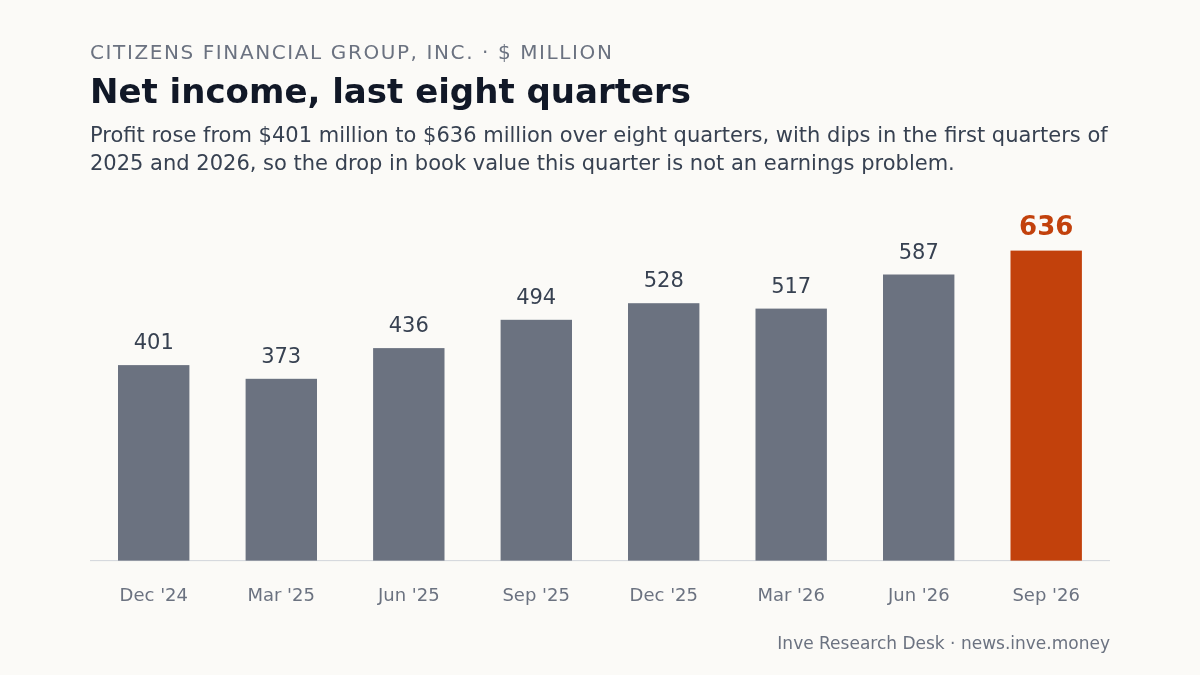
Higher long-term rates, not credit losses, took the equity
The company attributed the drop to higher long-term interest rates acting on its bond portfolio and its interest-rate swaps. When long rates rise, fixed-rate holdings already on the books are worth less. The unrealised loss is recorded in accumulated other comprehensive income (AOCI), which cuts tangible equity without passing through profit.
Citizens' regulatory CET1 ratio, its headline capital measure, leaves AOCI out, so it edged up to 10.5%. The measures that include it went the other way: the tangible common equity ratio (non-GAAP) fell, and the chief financial officer put the AOCI-adjusted CET1 ratio at 8.7%, against 9.5% at the end of 2025, as given on the January call.
Retained earnings do not explain the gap. After dividends and buybacks the bank kept only part of its profit, calculated from the release figures, yet tangible common equity fell $1,115 million. The difference, by our arithmetic, reflects the rate marks on securities and swaps together with smaller equity movements.
Stockholders' equity, last four balance-sheet dates
Equity had been roughly flat at about $26.2-26.3 billion until this quarter, when rate marks pulled it down despite profit.
$ million
| Equity | |
|---|---|
| Dec 2025 | 26,317 |
| Mar 2026 | 26,172 |
| Jun 2026 | 26,183 |
| Sep 2026 | 25,162 |
Deposits dipped, loans grew, and FHLB advances filled in
Deposits were slightly lower in the quarter while loans rose slightly, and the balance was filled with Federal Home Loan Bank (FHLB) advances, borrowing from a government-sponsored lender. They reached $7.6 billion, up sharply on a year earlier.
In July, management described FHLB use as temporary and expected deposit growth in the second half, especially the fourth quarter. On this call the CEO, noting he had said so before, said the balance should be meaningfully reduced by year-end and could come down to a low to mid single-digit number of billions from about $7 billion. The bank's explanation is seasonal: consumer deposits tend to dip in the third quarter and return. The year-end balance will show whether that holds, though year-end is also when commercial deposits are seasonally strong.
Total borrowed funds, last four balance-sheet dates
Borrowings have risen each period shown, which includes the FHLB advances the CEO expects to cut by year-end.
$ million
| Debt | |
|---|---|
| Dec 2025 | 11,282 |
| Mar 2026 | 12,314 |
| Jun 2026 | 16,349 |
| Sep 2026 | 17,832 |
Capital returns rise while tangible equity sits below 7%
The board raised the quarterly dividend and lifted repurchase capacity to $1.95 billion. The CEO said a tangible common equity ratio of 7% would be a reasonable level to be at or above and added: "So we're a tad below that." He called it not a binding ratio and said the bank is building capital.
Management's case for rebuilding rests on earnings, which add capital each quarter, and on Basel III changes that the CEO said would lift the adjusted ratio back to about 9.8%. The CEO described the Basel III relief as something that comes when the rules take effect. By our reading, the marks would also shrink if long-term rates fell or as the securities and swaps approach maturity. Until then, the company plans to return more cash in the fourth quarter (the higher dividend plus at least $200 million of buybacks, against $125 million in the third) on a smaller tangible base.
Citizens Financial Group stock page →
The record: notes, full financial tables
Notes
Impact 4/5 Balance sheet Negative
Citizens' tangible book value per share falls 6.6% to $35.78 in one quarter
Citizens said higher long-term rates cut the value of its securities and swaps. Tangible book value per share (non-GAAP) fell to $35.78 in the September 2026 quarter from $38.29 a quarter earlier and $36.73 a year ago, while the tangible common equity ratio (non-GAAP) fell to 6.7% from 7.4% a year earlier. The chief executive said 7% is a reasonable level to be at or above and that the bank is slightly below it. The company gave the AOCI-adjusted CET1 ratio as 9.4% on its October 2025 call and 9.5% on its January 2026 call (for the end of 2025); it is now 8.7%.
“So we're a tad below that.”— Bruce Van Saun, Chairman and CEO
Impact 4/5 Guidance Mixed
Citizens lifts dividend 13% to $0.52 and buyback capacity to $1.95B
The board raised the quarterly dividend to $0.52 from $0.46 and lifted repurchase capacity to $1.95 billion, $1.3 billion above the $650 million left under the June 2025 authorisation. The chief financial officer guided year-end CET1 to about 10.6%-10.7% including $200 million of fourth-quarter buybacks (the CEO called that a minimum), up from the 10.5%-10.6% guided on 21 January 2026. This comes as tangible common equity (non-GAAP) fell $1,115 million in the quarter.
“But I want to be in the market buying back the stock. I think the stock is cheap.”— Bruce Van Saun, Chairman and CEO
Impact 3/5 Balance sheet Mixed
Citizens' FHLB advances reach $7.6B; CEO says low-to-mid single-digit billions by year-end
Federal Home Loan Bank advances were $7,613 million at 30 September 2026, against $5,763 million at 30 June 2026 and $14 million a year earlier. On 16 July 2026 management had called the borrowing temporary and expected deposits to grow in the second half. The chief executive, who said he had given the year-end reduction on an earlier call, said on this call that advances could come down to a low to mid single-digit number of billions from about $7 billion.
“by the end of the year, we'll have that FHLB advanced number, I think, meaningfully reduced.”— Bruce Van Saun, Chairman and CEO
Impact 3/5 Guidance Positive
Citizens says its 16%-18% ROTCE target could arrive before the fourth quarter of 2027
The chief financial officer reiterated a clear path to 16%-18% return on tangible common equity (ROTCE, non-GAAP) by the end of 2027, and the chief executive said it could come sooner. ROTCE was 15.1% (non-GAAP) in the September 2026 quarter, against 13.9% a quarter earlier and 11.7% a year ago. The chief executive named the rate-driven fall in tangible equity as a small tailwind to the ROTCE calculation, and said he would reassess in January when guidance is given.
“It's possible that, that could pull in, and we don't have to wait all the way to the fourth quarter.”— Bruce Van Saun, Chairman and CEO
Impact 3/5 Guidance Mixed
Citizens' margin rose only 2 bps to 3.19%; CEO floats 2027 net interest income near 10%
Net interest margin (fully taxable-equivalent, non-GAAP) rose to 3.19% in the September 2026 quarter from 3.17% a quarter earlier and 3.00% a year ago, and the fourth-quarter guide of 3.23%-3.26% needs a larger step. That guide assumes a Federal Reserve rate rise in December. The chief executive declined to give 2027 guidance but said growth of around 10% in net interest income, against growth he put at over 12% for 2026, versus a January guide of 10% to 12%, would still be good.
“So if, in fact, it turned out to be kind of around 10% instead of over 12%, that's still pretty good.”— Bruce Van Saun, Chairman and CEO
Impact 2/5 Guidance Mixed
Citizens Private Bank assets $12.4B; January's $16-20B guide this call did not restate
Private Bank client assets were $12.4 billion at 30 September 2026, up $1.2 billion in the quarter. On 21 January 2026 the company guided year-end client assets of $16-20 billion, deposits of $18-20 billion and loans of $11-13 billion. Deposits of $18.5 billion and loans of $11.7 billion are already in range; client assets would need about $3.6 billion in a quarter to reach the range's low end, calculated from the reported figures, and the call did not restate that range.
Financials
Income statement, last 8 quarters
| Quarter end | Sales | YoY | Operating profit | Op. margin | PBT | Net profit |
|---|---|---|---|---|---|---|
| Sep 2026 | 2,322 | +9.6% | 929 | 40.0% | – | 636 |
| Jun 2026 | 2,283 | +12.1% | – | – | 755 | 587 |
| Mar 2026 | 2,168 | +12.0% | – | – | 650 | 517 |
| Dec 2025 | 2,157 | +8.6% | – | – | 677 | 528 |
| Sep 2025 | 2,118 | +11.4% | – | – | 629 | 494 |
| Jun 2025 | 2,037 | +3.8% | – | – | 554 | 436 |
| Mar 2025 | 1,935 | −1.2% | – | – | 468 | 373 |
| Dec 2024 | 1,986 | −0.1% | – | – | 508 | 401 |
Balance sheet
| As of | Equity | Debt | Cash | Fixed assets | Total assets |
|---|---|---|---|---|---|
| Sep 2026 | 25,162 | 17,832 | – | – | 234,464 |
| Jun 2026 | 26,183 | 16,349 | 12,760 | 873 | 233,836 |
| Mar 2026 | 26,172 | 12,314 | 12,330 | 874 | 227,918 |
| Dec 2025 | 26,317 | 11,282 | 12,727 | 915 | 226,351 |
| Sep 2025 | 25,829 | 10,655 | 11,650 | 857 | 222,747 |
Cash flow
| Year end | Operating | Investing | Financing |
|---|---|---|---|
| Dec 2025 | 2,211 | −5,967 | 5,882 |
| Dec 2024 | 2,001 | 2,987 | −6,015 |
| Dec 2023 | 2,961 | 5,248 | −7,128 |
| Dec 2022 | 4,119 | −12,637 | 9,907 |