
CarMax · KMX
CarMax's earnings per share jumped 81%, but it says half the sales gain is a regulatory tailwind
CarMax's earnings per share rose 81% last quarter, but the company says half its used-car sales gain came from regulation, and it has guided finance income lower for the year.
Published · Inve Research Desk

81.3%
growth in earnings per share last quarter
Earnings went from $0.64 to $1.16 a share, but about a third of the pretax gain came from two items that are not car sales.
How they did last quarter
Margin per car is inside the $200 guide (down $177 for the half) and costs are on track; sales and earnings jumped, but finance income is now guided below last year's.
- Used-car sales at open storesUp 13.0% on a year ago, against a 6.3% fall a year earliervs The quarter before, when the same measure was down 0.8%A sharp acceleration, but management puts about half of it on a regulatory tailwind and the base was weak.
- Diluted earnings per share$1.16, up 81.3%vs $0.64 a year earlierBy our arithmetic, about a third of the pretax gain came from mostly investment gains in other income and a loan-sale gain, not from selling cars.
- Used-car profit per unit$2,105, down $111 on a year agovs The company's earlier guidance of a $200 fall for the year; the half-year is down $177Margin per car is still being given up to win volume, though inside the guide.
- Income from the finance arm$135.6M, against $102.6M a year agovs Full-year income now guided slightly below last year'sThe lending arm's income rose in the half, and the company says the full year will come in slightly below last year.
The 81% is real, and part of it is not car sales
CarMax earned $1.16 a share in the August 2026 quarter, against $0.64 a year earlier. The business did get better: it sold more used cars at stores open a year. The question for an owner is how much of the gain is the kind that repeats.
Start with where the extra profit came from. About a third of the rise in pretax profit, by our arithmetic, came from two items that are not car sales: what the company says was mostly unrealized gains on a few equity investments, booked in other income, and a gain on selling auto loans that the year-earlier quarter did not have. Take both out and pretax profit still rose by roughly half, by our arithmetic. So the trend is up. It is just less steep than the headline.
Other income and pretax profit, last eight quarters
Other income was the highest of the eight quarters shown; pretax profit was well above a year earlier ($223.1M against $127.1M) but below the quarter before ($258.6M).
$ million
| Other income | PBT | |
|---|---|---|
| Nov 2024 | −5.4 | 167 |
| Feb 2025 | 14.1 | 118 |
| May 2025 | 0.3 | 283 |
| Aug 2025 | 3.6 | 127 |
| Nov 2025 | −4.5 | 84 |
| Feb 2026 | 7.6 | −111 |
| May 2026 | 2.1 | 259 |
| Aug 2026 | 18.6 | 223 |
Management puts half the sales gain on a regulator
Asked how much the FTC uplift mattered, the chief financial officer said the share CarMax earned through its own actions was about half of the quarter's comp: "those items that we control directly, we think is about half of the comp performance". The rest, he said, came from Federal Trade Commission enforcement of all-in price advertising, with compliance, he said, starting to move in May. The chief executive called it a tailwind for the remainder of this year. In June, by contrast, management credited competitive pricing and named no regulatory tailwind.
The base matters too. A year ago the same measure was falling. Stack the two years together and, by our arithmetic, the trend did not improve: it slipped a little from the quarter before, even as the headline jumped from a decline to a double-digit gain. Much of the jump is an easier comparison.
Finance income rose in the half but is guided down
Earlier this year the company gave no direction for income from CarMax Auto Finance, its in-house lender. On 29 September it said the year's income will be slightly lower than last year's, even as it pushes into borrowers with weaker credit. By our arithmetic last year's full-year figure was about $563M, so a full-year decline of even 1% leaves the second half roughly 12% below a year ago.
The share of used cars it financed also went the wrong way. It fell 1.7 points from a year ago, after a 1.5-point year-on-year rise to 43.3% in the quarter before. Management called it a normal response to higher rates, since CarMax raised what it charges prime borrowers. On 17 June Jon Daniels described a 50% mid-term objective for the lender, in an answer that also cited its Tier 2 share; the basis was not spelled out. The latest remarks did not mention it.
Charges are already named for the next two quarters
The company also named costs still to come. It is ending a legacy pension plan, which will book about $50M of non-cash settlement charges, split roughly evenly between the third and fourth quarters, plus a smaller severance charge in the third. None of the eight earlier calls we searched, back to September 2024, mentioned a pension.
The year-earlier quarter also carried an extra loan-loss provision on older loans, which flatters the comparison. Put the charges and the finance guide together and the second half is unlikely to look like the quarter just reported.
What we do not know yet
We do not know how much of the sales gain survives once the advertising rules have applied for a full year; by our reading, the tailwind began in May, so that test arrives next spring. The nearer checks are dated. The strategic update on 3 November should show whether the 50% goal returns and whether the efficiency savings meant to fund price cuts come with a number. The third-quarter results on 17 December 2026 face a weak base.
CarMax has not said it dropped the 50% goal. It has simply left it out, on the same day it guided income below last year's for the business that goal belonged to.
The record: notes, full financial tables
Notes
Impact 4/5 Demand Mixed
CarMax says about half of its 13% used-car sales jump came from regulation
Asked about the Federal Trade Commission's part in the quarter's strength, the chief financial officer estimated that CarMax's own actions were about half of the 13.0% gain in used-unit sales at open stores, with FTC enforcement of all-in price advertising, compliance moving from May, behind the rest. The same measure was down 0.8% the quarter before and 6.3% a year ago, so by our arithmetic the two-year trend slipped from about 7.2% to 5.9%. In June management credited more competitive pricing and named no regulatory tailwind; the chief executive now calls it a tailwind for the remainder of this year.
“those items that we control directly, we think is about half of the comp performance”— Enrique Mayor-Mora, chief financial officer
Impact 4/5 Guidance Negative
CarMax guides finance income slightly lower for FY27 after a first-half rise
The head of CarMax Auto Finance said the year's income will be slightly lower than last year's; no direction had been given on 14 April or 17 June. First-half income was $275.8M against $244.3M, including a $16.6M gain on loan sales in the latest quarter. By our arithmetic, with last year's full year near $563M, a 1% decline leaves the second half roughly 12% lower. More detail is due at the 3 November strategic update.
“we anticipate CAF's FY '27 income will be slightly lower than FY '26”— Jon Daniels, EVP CarMax Auto Finance
Impact 3/5 One-off Mixed
A third of CarMax's $96M pretax gain came from two non-sales items; $56M of charges follow
Pretax profit rose to $223.1M from $127.1M in the quarter. Other income rose $14.9M and the finance arm booked a $16.6M gain on loan sales, together about a third of the rise by our arithmetic; without them pretax profit rose about 52%. The company flagged about $50M of non-cash pension settlement charges across the next two quarters and about $6M of severance in the third. None of the eight earlier calls we searched, September 2024 to June 2026, mentioned a pension.
“unrealized gains on a small number of equity investments”— Enrique Mayor-Mora, chief financial officer
Impact 3/5 Margin Mixed
CarMax: margin per used car to fall less than $200 this year; first half is down $177
The chief financial officer said full-year retail margin per used car will fall by less than the $200 cut the company restated on 17 June, with declines also expected in the third and fourth quarters. Margin per unit was $2,105 in the quarter against $2,216 a year ago, and $2,141 for the half against $2,318. On 14 April the company had guided a fall broadly in line with the prior quarter's $207 decline.
“We expect FY '27 full year retail margins will be down less than the $200 per unit as compared to FY '26.”— Enrique Mayor-Mora, chief financial officer
Impact 3/5 Risk Negative
CarMax's lender financed a 1.7-point smaller share of used cars; 50% goal went unmentioned
The share of used cars CarMax Auto Finance financed fell to 40.9% from 42.6% a year ago, after a 1.5-point year-on-year rise to 43.3% the quarter before. Its head said penetration among its best-credit (Tier 1) borrowers fell after CarMax raised rates on higher funding costs, while the lender financed 22% of lower-credit volume, against 10% a year ago. In June Jon Daniels described a 50% mid-term objective, in an answer that also cited its Tier 2 share; the latest call did not mention it.
“We view this as a normal response to the higher interest rate environment versus a structural change in behavior from CarMax customers.”— Jon Daniels, EVP CarMax Auto Finance
Impact 3/5 Balance sheet Positive
CarMax will resume share buybacks in the third quarter, at a modest pace
CarMax said it will restart repurchases in the third quarter at a level below its average quarterly pace before the pause, to manage net leverage; $1.31B of authorization remains. It repurchased $2.6M of stock in the first half against $384.9M a year earlier, and none in the latest quarter. In June it called leverage slightly above its target range and said capital would return at the appropriate time. The size of the first purchase is not known; third-quarter results are due on 17 December 2026.
“we intend to resume share repurchases at a modest level in the third quarter”— Keith Barr, president and chief executive officer
Financials
Income statement, last 8 quarters
| Quarter end | Sales | YoY | Other income | PBT | Net profit |
|---|---|---|---|---|---|
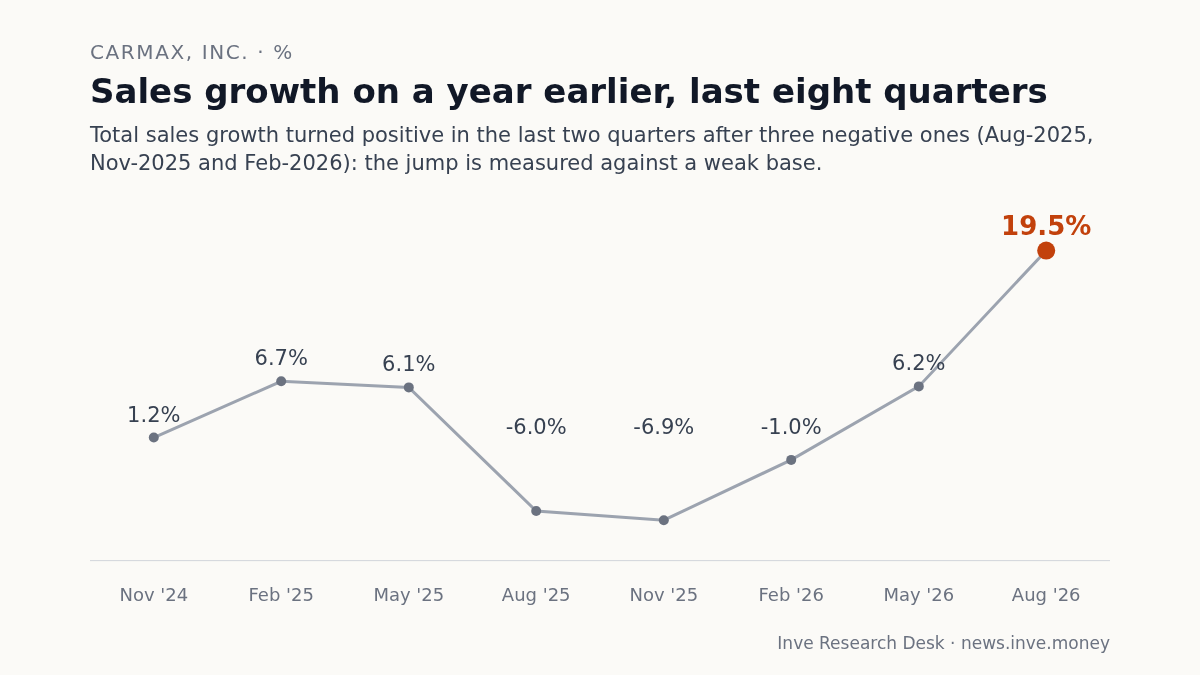
| Aug 2026 | 7,878 | +19.5% | 18.6 | 223 | 165 |
| May 2026 | 8,014 | +6.2% | 2.1 | 259 | 186 |
| Feb 2026 | 5,946 | −1.0% | 7.6 | −111 | −121 |
| Nov 2025 | 5,794 | −6.9% | −4.5 | 84 | 62 |
| Aug 2025 | 6,595 | −6.0% | 3.6 | 127 | 95 |
| May 2025 | 7,547 | +6.1% | 0.3 | 283 | 210 |
| Feb 2025 | 6,003 | +6.7% | 14.1 | 118 | 90 |
| Nov 2024 | 6,223 | +1.2% | −5.4 | 167 | 125 |
Balance sheet
| As of | Equity | Debt | Cash | Fixed assets | Total assets |
|---|---|---|---|---|---|
| Aug 2026 | 6,305 | 17,375 | 171 | 4,079 | 26,068 |
| May 2026 | 6,119 | 18,132 | 132 | 4,080 | 26,627 |
| Feb 2026 | 5,889 | 18,023 | 123 | 4,070 | 26,368 |
| Nov 2025 | 6,065 | 17,326 | 205 | 4,024 | 25,562 |
Cash flow
| Year end | Operating | Investing | Financing | Free cash flow |
|---|---|---|---|---|
| Feb 2026 | 1,784 | −540 | −1,341 | 1,243 |
| Feb 2025 | 624 | −461 | −454 | 157 |
| Feb 2024 | 459 | −467 | 308 | −7 |
| Feb 2023 | 1,283 | −426 | −710 | 861 |