
Cal-Maine Foods · CALM
Cal-Maine said in July its first quarter could price slightly better; September would not call the bottom
Cal-Maine's conventional egg loss widened to $71.0M after July's view that egg pricing could edge up, and with no date for a turn, the dated fact is a cash pile that shrank.
Published · Updated · Inve Research Desk
-15.2%
operating margin in the quarter to 29 August 2026
The company spent more than it sold, against a 27.0% margin a year earlier.
How they did last quarter
The conventional egg loss widened after July's guidance that egg pricing could improve slightly; our tables hold no selling price for the two quarters, so the guide cannot be scored directly.
- Conventional egg operating loss$71.0M loss, price realization 99% of the benchmark marketvs July guidance: "could have a slight improvement over Q4 in conventional egg pricing"; loss of $40.6M and realization of 101% the quarter beforeThe loss widened by $30.5M by our arithmetic; the tables below hold no first-quarter selling price, so the guide cannot be scored directly.
- Operating cash flow$101.4M used in the quartervs $2.8M produced the quarter beforeThe business turned from roughly break-even cash to a drain, and the cash pile fell with it.
- Prepared Foods margin12.4% segment marginvs 14.6% the quarter before and 18.3% a year earlierVolume fell 19.3% and the segment's chief financial officer said start-up costs follow in the second quarter.
A slight improvement was expected; a wider loss arrived
In July Cal-Maine said it believed the first quarter could show a slight improvement over the quarter before in conventional egg pricing. In the quarter just reported, the conventional egg business, the part that decides this company's results, lost $71.0M, against a loss of $40.6M the quarter before.
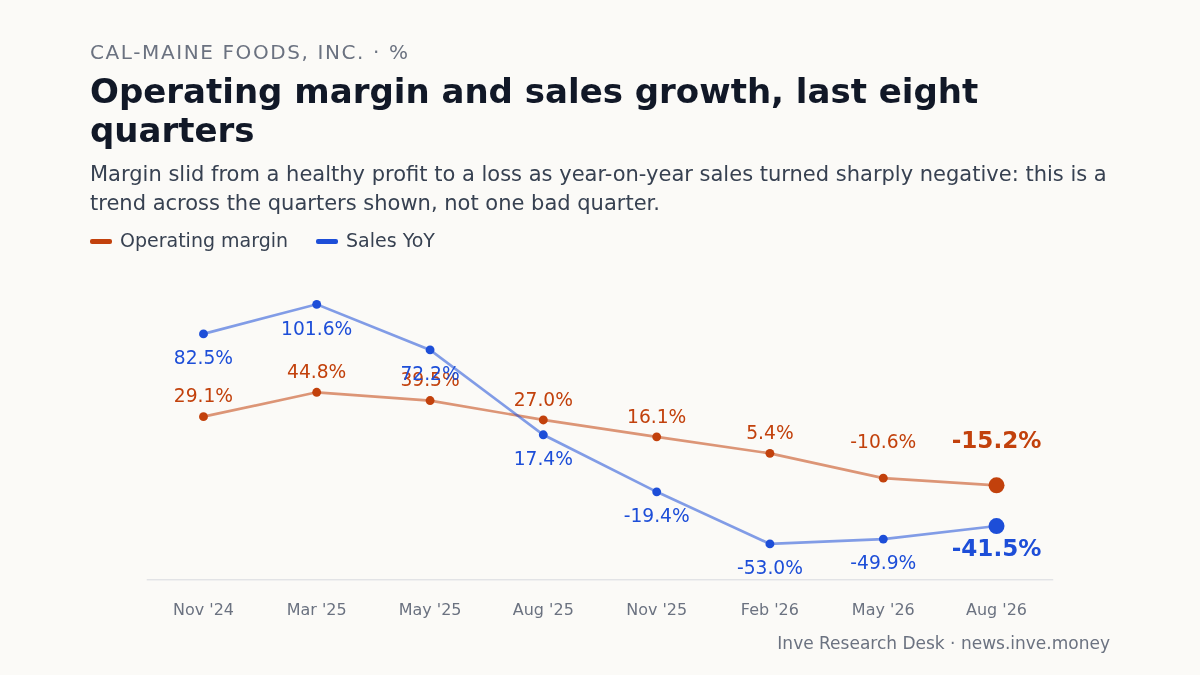
The company as a whole spent more than it sold: operating margin was -15.2%, the lowest of the eight quarters shown. The company's explanation is a lag. Much of its business is priced a step behind the market, so a rise in egg prices in late August hurt, and its price realization against the benchmark market slipped slightly. The filed numbers cannot separate that lag from everything else.
In September the company declined to call the bottom
The company also pointed to signs that egg supply is shrinking. Management cited American Egg Board estimates putting the national laying flock at 336 to 343 million, about 4 million below the board's previous estimate (340 to 347 million on the July call), and USDA data showing August hatchings 12% below a year earlier. It also cited fall demand, and noted that bird flu, which historically rises with fall migration, could tighten supply, but it did not forecast when egg prices would turn.
Then came the sentence that matters. The chief executive, Sherman Miller, said: "We are not attempting to call the precise bottom in the conventional egg cycle." The flock figure is a producer-survey estimate, and the July range rested on older data that the company itself said might overstate the flock. In July it pointed to a more robust trajectory coming out of the first quarter. In September it said it was not attempting to call the bottom.
The one dated fact is a cash pile that is shrinking
Cash and short-term investments stood at $767.6M at the end of August, down $156.5M in the quarter. Operating activities used $101.4M of cash in the quarter; the quarter before had produced a small inflow. Of that, $113.5M was cash and $654.1M was short-term available-for-sale investments.
The company is also repurchasing its own shares, and it has said it will pay no dividend until a cumulative loss, which has grown since July, is recovered. Using a large balance that way is defensible. It is also the balance that the rest of the plan is paid from.
Cash from operations, last four fiscal years
Cash generation was already far lower in the latest fiscal year than the year before, so this quarter's outflow is drawn from a smaller stream than it was.
$ million
| Operating cash flow | Free cash flow | |
|---|---|---|
| Jun 2023 | 863 | 726 |
| Jun 2024 | 451 | 304 |
| May 2025 | 1,225 | 1,064 |
| May 2026 | 480 | 329 |
The second plan faces start-up costs next quarter
Cal-Maine's answer to the egg cycle is a prepared-foods business it controls. Its segment margin was 12.4% in the quarter, against 14.6% the quarter before. In April the company called its fiscal third quarter a trough and guided to a progressive recovery beginning in its fourth quarter, with margins trending back toward baseline through fiscal 2027 and 2028. The quarter before was that fourth quarter; we do not hold the third-quarter figure, and the April guide ran well beyond one quarter.
The segment's chief financial officer said the second quarter will carry start-up costs for capacity being brought online in it, as the first quarter did for the initial capacity added late in that quarter, and that the company is not giving margin guidance for Prepared Foods for the full year.
What we do not know yet
Between the July and September calls, Cal-Maine went from expecting a slight improvement in conventional egg pricing to declining to call the bottom. We do not know yet whether the late-August rise in egg prices will lift the next quarter, which ends in late November 2026, given that the company's pricing trails the market. Nor do we know whether the board's next flock estimate will be lower again. The next quarterly results will show some of it.
On the call, Cal-Maine did not announce that a forecast had been withdrawn. It gave a direction in July and a disclaimer in September, and in between it moved the discussion to what it can steer itself: its plants and its cash.
The record: notes, full financial tables
Notes
Impact 4/5 Guidance Negative
Cal-Maine's egg loss widens to $71.0M after July said pricing could edge up
The company's conventional egg segment lost $71.0M in the quarter to 29 August 2026, against a loss of $40.6M the quarter before and a profit of $168.2M a year earlier. Whole-company operating margin was -15.2%, down from -10.6% the quarter before and 27.0% a year ago. On 22 July the company said it believed the first quarter could have a slight improvement in conventional egg pricing; our tables hold no first-quarter selling price to score that against, and the company's explanation for the slip in realization is a pricing lag behind the market.
“We are not attempting to call the precise bottom in the conventional egg cycle.”— Sherman Miller, President and CEO
Impact 3/5 Demand Mixed
Cal-Maine cites a flock estimate 4M lower; CEO says it does not show a turn
Management cited American Egg Board estimates putting the national laying flock at 336 to 343 million, about 4 million below the board's previous estimate (340 to 347 million on the July call), and USDA data showing August hatchings 12% below a year earlier. The CEO said these indicators did not establish that the market will turn. The board's July range rested on May data, which the company then said might overstate the flock. He added that a meaningful layer outbreak of bird flu, which historically rises with fall migration, could tighten supply.
“could tighten supply and support egg prices because relatively small changes in supply can have an outsized market impact”— Sherman Miller, President and CEO
Impact 4/5 Balance sheet Mixed
Cal-Maine's cash and short-term investments fall $156.5M in a quarter to $767.6M
Operating activities used $101.4M of cash in the quarter to 29 August 2026, against $2.8M produced the quarter before. Cash and short-term investments fell to $767.6M from $924.1M at the end of May; of that, $654.1M was available-for-sale investments. The company is also repurchasing shares and has said it will pay no dividend until a cumulative loss, which has grown since July, is recovered.
“Rather than retrenching when commodity economics are weak, we have the financial capacity to invest through the cycle.”— Sherman Miller, President and CEO
Impact 3/5 Margin Mixed
Cal-Maine's Prepared Foods margin falls to 12.4%; segment CFO flags Q2 start-up costs
Prepared Foods earned a segment margin of 12.4% in the quarter to 29 August 2026, down from 14.6% the quarter before and 18.3% a year earlier, on volume down 19.3%. In April the company guided to a progressive recovery beginning in its fiscal fourth quarter, with margins trending back toward baseline through fiscal 2027 and 2028; we do not hold the third-quarter margin. The segment's chief financial officer now says the second quarter will carry start-up costs for new capacity, and the company is not giving full-year margin guidance for Prepared Foods.
“in Q2, we're going to have some upfront costs for the capacity that we're bringing online this quarter”— Johnathan Zoeller, CFO, Prepared Foods
Financials
Income statement, last 8 quarters
| Quarter end | Sales | YoY | Operating profit | Op. margin | Other income | PBT | Net profit |
|---|---|---|---|---|---|---|---|
| Aug 2026 | 540 | −41.5% | −82 | −15.2% | 8.0 | −74 | −59 |
| May 2026 | 553 | −49.9% | −59 | −10.6% | 12.3 | −47 | −36 |
| Feb 2026 | 667 | −53.0% | 36 | 5.4% | 22.2 | 58 | 51 |
| Nov 2025 | 770 | −19.4% | 124 | 16.1% | 12.2 | 136 | 103 |
| Aug 2025 | 923 | +17.4% | 249 | 27.0% | 14.1 | 263 | 199 |
| May 2025 | 1,104 | +72.2% | 436 | 39.5% | 17.3 | 453 | 343 |
| Mar 2025 | 1,418 | +101.6% | 636 | 44.8% | 27.4 | 663 | 509 |
| Nov 2024 | 955 | +82.5% | 278 | 29.1% | 10.9 | 289 | 219 |
Balance sheet
| As of | Equity | Cash | Investments | Fixed assets | Total assets |
|---|---|---|---|---|---|
| Aug 2026 | 2,570 | 114 | 654 | 1,312 | 3,013 |
| May 2026 | 2,633 | 107 | 817 | 1,318 | 3,108 |
| Feb 2026 | 2,700 | 392 | 760 | 1,221 | 3,139 |
| Nov 2025 | 2,692 | 370 | 770 | 1,219 | 3,144 |
Cash flow
| Year end | Operating | Investing | Financing | Free cash flow |
|---|---|---|---|---|
| May 2026 | 480 | −504 | −363 | 329 |
| May 2025 | 1,225 | −576 | −387 | 1,064 |
| Jun 2024 | 451 | −413 | −94 | 304 |
| Jun 2023 | 863 | −375 | −254 | 726 |