
Cal-Maine Foods · CALM
Cal-Maine's egg segment lost more than the quarter before, after July said pricing could improve slightly
In July Cal-Maine said conventional egg pricing could improve slightly; the quarter that followed lost more, and on 30 September management said it was not trying to call the bottom and pointed to prepared foods.
Published · Inve Research Desk
$0.4 million
gross profit on $539.6 million of net sales last quarter
After the direct cost of producing the eggs, almost nothing was left, against $311.3 million a year earlier.
How they did last quarter
Worse than the quarter before, against a July view that conventional pricing could improve slightly: the egg segment lost more, cash flow turned negative, and prepared foods gave back margin.
- Conventional egg segmentOperating loss of $71.0 million on $201.7 million of sales; sales down 4.3% on the quarter before, by our arithmeticvs 22 July: "we believe Q1 could have a slight improvement over Q4 in conventional egg pricing"; the quarter before lost $40.6 millionThe segment that sets the year's earnings lost more where July had said pricing could improve slightly.
- Prepared Foods operating margin12.4% on $63.0 million of salesvs 14.6% the quarter before and 18.3% a year agoThe cost of building capacity arrived before the benefit; the segment gave back margin.
- Operating cash flowAn outflow of $101.4 millionvs An inflow of $2.8 million the quarter beforeThe company is now funding its losses and its expansion from its cash pile.
The loss widened where July had said pricing could improve
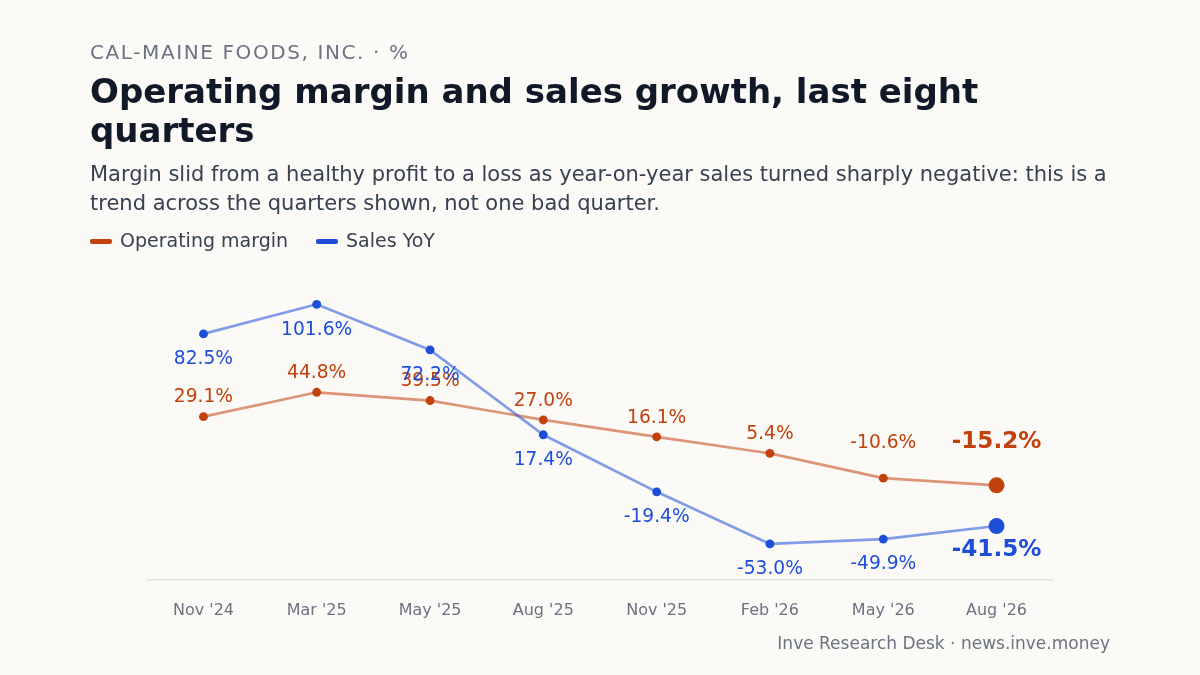
Cal-Maine Foods, the egg producer, sold $539.6 million in the August 2026 quarter and kept $0.4 million of it after the direct cost of producing it. Below that line it lost money: an operating margin of -15.2%, which means it spent about $1.15 for every dollar it took in, by our arithmetic.
That was not what July had pointed to for conventional eggs. On 22 July the company said conventional egg pricing could have a slight improvement in the quarter. The same call put the market price for the first five weeks of the quarter at $0.72 against $1.08 for the quarter before, and called the period a seasonal low. The conventional segment, which sells ordinary shell eggs, then lost $71.0 million, up from a loss of $40.6 million. Its sales fell 4.3% on the quarter, by our arithmetic, so the improvement did not show up in the segment's result. The chief financial officer put it down to timing: "Our pricing approach has not changed the direction and timing of the market did." Conventional eggs are priced behind the market, so a late spike did not reach the quarter's realized prices. That may be right, and it would help the next quarter.
Sales and operating profit, last eight quarters
Sales fell far faster than costs, so operating profit went from large profits to a loss: the cost base did not shrink with revenue.
$ million
| Sales | Operating profit | |
|---|---|---|
| Nov 2024 | 955 | 278 |
| Mar 2025 | 1,418 | 636 |
| May 2025 | 1,104 | 436 |
| Aug 2025 | 923 | 249 |
| Nov 2025 | 770 | 124 |
| Feb 2026 | 667 | 36 |
| May 2026 | 553 | −59 |
| Aug 2026 | 540 | −82 |
In September the company would not call the bottom
In July management spoke of a better balance between supply and demand and a more constructive egg-price environment heading into the fall. On 30 September the chief executive, Sherman Miller, said: "We are not attempting to call the precise bottom in the conventional egg cycle." He described two clocks: the egg market, which management says it cannot precisely predict, and prepared foods, where it says it has considerably greater visibility. It also cited fall demand and the seasonal bird-flu curve, but framed them as supports for demand, not as a forecast that egg prices would turn.
There are early signs of tighter supply, but they are small, and the company itself said they fall short of showing that the market will turn. Management cited industry estimates that the national laying flock fell between its two most recent calls, by our arithmetic, and that August hatchings were well below a year earlier. Those are third-party numbers repeated by the company.
The clock the company controls is still small
Prepared foods earned a 12.4% operating margin last quarter, below the quarter before and a year earlier, and its volume fell on a year ago. By our arithmetic the whole segment earned about a ninth of what conventional eggs lost.
Management reaffirmed a plan to raise prepared-foods capacity by more than half, and the segment's finance chief said the current quarter carries upfront costs for capacity coming online. Capacity comes first and customers follow, so a holder sees the cost before the benefit. In July management dated two milestones: a pancake line early in the current quarter and a scrambled-egg line around its middle. Those are what can be checked.
Cash is paying for the wait, and the cushion is not endless
Operating cash flow was an outflow of $101.4 million, after positive operating cash flow in each of the previous 19 quarters, back to the quarter to 27 November 2021. Cash and temporary cash investments fell to $767.6 million, and management calls the company virtually debt free. At the quarter's pace of decline the cushion lasts about five more quarters, by our arithmetic. On 22 July management called the first fiscal quarter a seasonal pricing low, so the pace need not repeat.
On cost, selling and administrative expense was up on a year ago while sales fell much further. Management attributed part of the rise to acquisitions and legal and professional fees, and said the corporate cost level is about where it expects it to be as the business grows; the line was lower than the quarter before.
What we do not know yet
We do not know what the late-August price rise does to realized prices in the current quarter; the next report will show it. Management pointed to the back half of this year for top-line growth from the new capacity and declined to guide margins; we do not know whether volume, down 19.3% on a year ago, turns up by then.
On the two calls we read, Cal-Maine went from describing a more constructive egg-pricing environment heading into the fall to saying it was not trying to call the bottom, and the quarter between them was worse than the one before. What management does date is what it builds: capacity lines and the months they open. A company that cannot date its recovery and can date its construction is telling you which of the two it is willing to be held to.
The record: notes, full financial tables
Notes
Impact 4/5 Margin Negative
Cal-Maine conventional eggs lose $71.0M after July said pricing could improve
Cal-Maine's conventional shell-egg segment lost $71.0 million in the quarter ended 29 August 2026 on $201.7 million of sales, a margin of -35.2%, against a loss of $40.6 million the quarter before. On 22 July the company said the quarter could bring a slight improvement in conventional egg pricing, while putting the first five weeks' market price at $0.72 against $1.08 in the quarter before and calling the period a seasonal low. The chief financial officer now says pricing lags the market, so a late-August spike did not reach realized prices. Total gross profit was $0.4 million.
“Our pricing approach has not changed the direction and timing of the market did.”— Max Bowman, VP and CFO
Impact 4/5 Guidance Negative
Cal-Maine won't call the egg bottom after July pointed to a better fall; margin -15.2%
On 30 September Cal-Maine's chief executive said the company is not trying to call the bottom of the egg cycle; on 22 July it had pointed to a more constructive pricing environment heading into the fall, though it also pointed to stronger fall demand. Industry estimates quoted on the call put the U.S. laying flock at 336 to 343 million, about 4 million below the July estimate, with August hatchings 12% lower than a year earlier, though the company itself said these indicators fall short of showing the market will turn. Operating margin was -15.2% last quarter against -10.6% the quarter before.
“We are not attempting to call the precise bottom in the conventional egg cycle.”— Sherman Miller, President and CEO
Impact 4/5 Balance sheet Negative
Cal-Maine operating cash flow turns to a $101.4M outflow; cash falls $156.5M
Cal-Maine's operations used $101.4 million of cash in the quarter ended 29 August 2026, after positive operating cash flow in each of the previous 19 quarters, back to the quarter to 27 November 2021. Cash and temporary cash investments fell to $767.6 million from $924.1 million, a drop of $156.5 million by our arithmetic. The company spent $26.6 million on capital projects and $25 million on additional Eggland's Best territory, and management calls it virtually debt free. The quarter before, operating cash flow was an inflow of $2.8 million.
“we have the financial capacity to invest through the cycle.”— Sherman Miller, President and CEO
Impact 3/5 Margin Mixed
Cal-Maine Prepared Foods margin slips to 12.4% as capacity costs arrive first
Prepared Foods earned $7.8 million on $63.0 million of sales in the quarter ended 29 August 2026, a margin of 12.4% against 14.6% the quarter before and 18.3% a year earlier. Volume fell 19.3% on a year ago. On 1 April the company said margin recovery would show late in fiscal 2027 and into fiscal 2028; that window is still ahead, so 12.4% does not contradict it. The company kept its plan for capacity to rise more than 60% by the first half of fiscal 2028.
“in Q2, we're going to have some upfront costs for the capacity that we're bringing online this quarter”— John Zoeller, CFO, Prepared Foods
Impact 3/5 Balance sheet Mixed
Cal-Maine buys back $14.9M of stock after quarter-end; dividend waits on $94.5M loss
Cal-Maine bought about $5 million of its shares in the quarter ended 29 August 2026 and $14.9 million after it closed, with $315.7 million left of a $500 million authorization at quarter-end. Under its variable dividend policy no cash dividend is paid until it is profitable on a cumulative basis, and the cumulative loss to recover is now $94.5 million, up from $35.9 million at the July call.
“it shows that we see a big value at these levels of stock.”— Sherman Miller, President and CEO
Impact 3/5 Margin Negative
Cal-Maine overhead rises 17.5% as sales fall 41.5%; feed expected to keep rising
Cal-Maine's selling and administrative expense was $81.7 million in the quarter ended 29 August 2026, up 17.5% from a year earlier while net sales fell 41.5%, taking it to 15.1% of sales from 7.5%, though it was 12.8% below the $93.6 million of the quarter before, by our arithmetic. Management attributed part of the rise, about $8.5 million of corporate overhead, to acquisitions (Creighton, Clean Egg) and higher legal and professional fees, and said that corporate cost is about where it expects it to be as the business grows. It also said feed cost was up 4.3% on a year ago and is expected to keep rising.
“So we do expect that feed will continue to be up”— Sherman Miller, President and CEO
Financials
Income statement, last 8 quarters
| Quarter end | Sales | YoY | Operating profit | Op. margin | Other income | PBT | Net profit |
|---|---|---|---|---|---|---|---|
| Aug 2026 | 540 | −41.5% | −82 | −15.2% | 8.0 | −74 | −59 |
| May 2026 | 553 | −49.9% | −59 | −10.6% | 12.3 | −47 | −36 |
| Feb 2026 | 667 | −53.0% | 36 | 5.4% | 22.2 | 58 | 51 |
| Nov 2025 | 770 | −19.4% | 124 | 16.1% | 12.2 | 136 | 103 |
| Aug 2025 | 923 | +17.4% | 249 | 27.0% | 14.1 | 263 | 199 |
| May 2025 | 1,104 | +72.2% | 436 | 39.5% | 17.3 | 453 | 343 |
| Mar 2025 | 1,418 | +101.6% | 636 | 44.8% | 27.4 | 663 | 509 |
| Nov 2024 | 955 | +82.5% | 278 | 29.1% | 10.9 | 289 | 219 |
Balance sheet
| As of | Equity | Cash | Fixed assets | Total assets |
|---|---|---|---|---|
| Aug 2026 | 2,570 | 114 | 1,312 | 3,013 |
| May 2026 | 2,633 | 107 | 1,318 | 3,108 |
| Feb 2026 | 2,700 | 392 | 1,221 | 3,139 |
| Nov 2025 | 2,692 | 370 | 1,219 | 3,144 |
Cash flow
| Year end | Operating | Investing | Financing | Free cash flow |
|---|---|---|---|---|
| May 2026 | 480 | −504 | −363 | 329 |
| May 2025 | 1,225 | −576 | −387 | 1,064 |
| Jun 2024 | 451 | −413 | −94 | 304 |
| Jun 2023 | 863 | −375 | −254 | 726 |